A product’s weight, temperature and edge profile do not by themselves justify replacing a belt with a slat conveyor. You will be able to test the actual load, identify the failure risks, compare alternative conveyor types and request a specification based on chain pull, heat exposure and product geometry.
Key takeaways
- Measure weight, footprint, drop height, temperature and edge condition first.
- Size for point loads, impact energy and motor starting torque.
- Choose slat, frame and component materials for heat, corrosion and hygiene.
- Compare slats with belts, rollers, wire mesh and aprons before ordering.
Test Whether the Product Really Needs Slats
Measure the product before starting slat conveyor selection. Record its maximum weight, smallest bearing footprint, point-load location, drop height at loading, operating temperature, and the edge radius or burr height.
A product is a stronger slat candidate when it punctures or cuts a belt, concentrates load on a few supports, or applies enough starting resistance to make a belt slip. Steel slats also handle repeated impact better than many belt surfaces, but they do not eliminate snagging at joints or transfers.
Use these tests:
- Place the heaviest product on the smallest contact area and calculate force per support, not just total weight.
- Drop the product from its actual loading height and inspect slats, fasteners and transfer gaps for impact damage or corner catches.
- Run the sharp-edged products through every orientation; a corner that catches a slat joint disqualifies the layout.
- Measure the hottest product surface and the surrounding air during both continuous and intermittent operation.
- Check whether the product slides, rolls or bridges between supports when spacing changes.
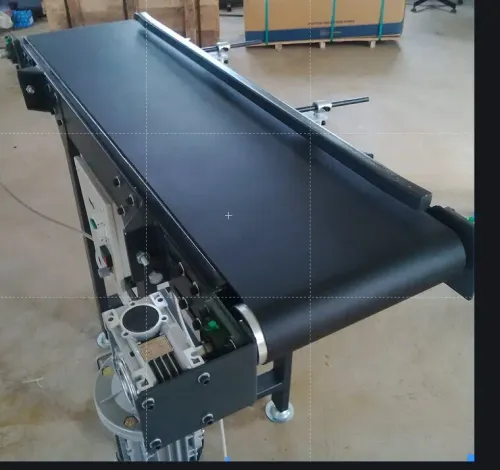
| Conveyor type | Measurable condition favoring it | Main failure concern |
|---|---|---|
| Belt conveyor | Low point load, smooth underside, moderate temperature and clean traction surface | Cutting, slip or belt stretch |
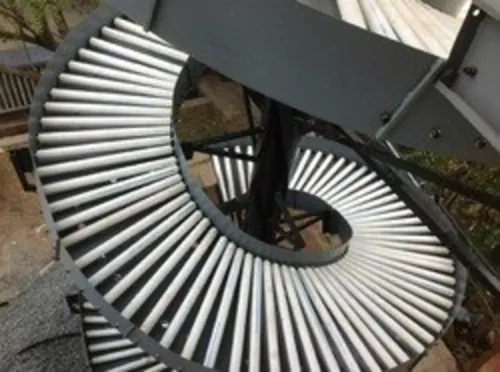
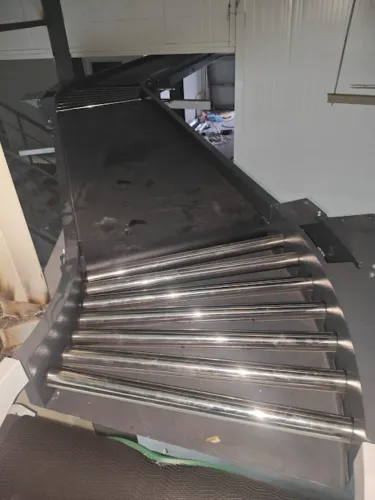
| Roller conveyor | Rigid, stable base with enough length to contact several rollers | Small footprints, gaps or unstable orientation |
| Drag conveyor | Bulk material or products that tolerate floor contact | Scratching, crushing or accumulation damage |
| Slat conveyor | Heavy products, sharp-edged products, concentrated loads or high starting torque | Chain tension, transfer gaps and higher maintenance |
Size the Conveyor for Point Loads, Impacts and Starting Torque
The maximum product weight is only one input. A 90 kg part placed gently across several slats creates a different load from the same part dropped onto one slat or concentrated at a narrow contact point.
Use the actual loading pattern to separate distributed load from point load. Distributed load lowers local slat, chain and frame stress; a point load raises it and can bend slats, damage wear strips or deflect the frame.
Product spacing also changes chain pull: tightly spaced products increase the average load, while widely spaced products create sharper load changes as each item enters the conveyor.
Give the designer these operating details:
- maximum product weight, dimensions, contact area and centre of gravity
- product spacing at minimum, normal and maximum rates
- loading height, drop distance, impact angle and allowable impact energy
- conveyor length, incline, speed, start-stop frequency and accumulation conditions
- required acceleration and the number of loaded products during startup
Starting torque determines whether the chain can move the worst-case load without stretching, skipping or overloading the motor, shaft, bearings and sprockets. Ask for the calculated chain pull, chain’s allowable working tension, drive torque and service factor—not a “heavy-duty” label.
Check transfers with the real product. A sharp corner landing across a nose-over gap can create a brief impact far above the running load, even when the conveyor carries the product comfortably once it is moving.
Match Slat and Component Materials to Heat, Corrosion and Hygiene
Choose material from the hottest condition the complete conveyor will experience, not from the slat’s softening point alone. Record product contact temperature, ambient temperature, radiant heat, continuous temperature, intermittent exposure, contact duration, accumulation dwell and cooling time.
A part that is safe while moving can heat-soak during a stop, driving lubricant from chain joints, hardening seals, shortening polymer wear strips and increasing thermal expansion.
| Material | Strengths | Choose it when | Watch-outs |
|---|---|---|---|
| Mild steel | High impact and puncture resistance; economical | The product is sharp, heavy, hot and the area stays dry | Rust, scale and wash chemicals can damage it; coating failure exposes bare steel |
| Stainless steel | Corrosion resistance and easier cleaning | Washdown, oils, chemicals or hygiene controls matter | Select the grade and finish for the chemical exposure; stainless does not eliminate crevices or trapped debris |
| Plastic | Low friction, quiet running and resistance to selected chemicals | Product temperature stays within the polymer’s rating and gentle handling matters | Verify heat, solvent and abrasion limits; thermal expansion can change tracking and joint gaps |
Ask for separate maximum ratings for the slat, chain, hinge pins, wear strips, bearings, seals, lubricant, motor insulation and guarding. The lowest-rated component sets the design limit. Specify both the maximum product temperature and ambient temperature, including radiant heat and heat soak during accumulation.
A stainless frame with open chain, non-sealed bearings or debris-trapping gaps is not automatically hygienic or washdown capable. For hot products, also state allowable dwell time and back pressure: sliding accumulation adds frictional heat and chain pull even when the slat itself remains intact.
Check Product Geometry, Transfers and Mechanical Details Before Ordering
A product that clears the slats can still fail at the transfer. Test the actual part at operating speed, with its normal orientation and spacing, because burrs, protrusions, unstable bases and sharp corners expose problems an empty conveyor will not show.
| Product feature | Likely failure | Design check |
|---|---|---|
| Burrs or protrusions | Snagging on slat gaps, side guides or dead plates | Match slat pitch, guide clearance and nose-over geometry to the largest projection |
| Unstable bases | Tipping, rotation or falling between slats | Confirm contact area, centre of gravity and support through every transfer |
| Abrasive scale | Rapid wear of slats, wear strips and chain joints | Specify wear-resistant surfaces and inspect debris traps |
| Heavy, sharp corners | Impact at the next conveyor or damage to end rollers | Support the leading edge and minimise unsupported transfer distance |
Ask the supplier to run a loaded transfer trial, including starts, stops, incline operation and the worst-case product orientation. Check side guides, flights, end rollers, sprockets, chain tension, frame deflection and the clearance beneath wear strips; trapped chips and scale accelerate wear.
Guard chain drives, sprockets, nip points and return runs. In the United States, review OSHA 29 CFR 1910.212 for machine guarding and 29 CFR 1910.219 for exposed power-transmission parts. A washdown label does not remove the risk: open chain, carbon-steel frames, unsealed bearings and crevices can retain water, oil or debris.
- Require the layout to show every transfer gap and pinch point.
- Confirm the product cannot reach moving chains or guides.
- Specify inspection access for slats, bearings, wear strips and chain tension.
Compare Slats With Belts, Rollers, Wire Mesh and Aprons
Choose slats when a belt’s surface would cut, soften, stretch or slip, and when replacing individual plates is preferable to splicing or replacing a damaged belt. That benefit must justify extra mechanical complexity, hinge and sprocket wear, transfer sensitivity, noise and maintenance. Slats are not the best choice for quiet conveying of uniform products.
| Option | Main advantage | Main drawback | Choose it when |
|---|---|---|---|
| Belt conveyor | Lowest mechanical complexity and smooth, quiet transport | Cuts, heat, sharp edges and high starting loads can damage or slip the belt | Products are stable, moderate-temperature and evenly loaded |
| Roller conveyor | Low surface contact and easy accumulation for rigid, flat products | Small or pointed products can snag, bridge or fall between rollers | Loads have a firm base and require gravity or zero-pressure accumulation |
| Wire-mesh conveyor | Airflow, drainage and oven or washdown capability | Open structure can mark, tip or lose small parts | Cooling, drying, cleaning or thermal exposure matters |
| Slat conveyor | Positive drive, rigid support and replaceable conveying plates | More wear points, noise, chain pull and transfer demands | Products are hot, sharp, heavy, oily or impact-prone |
| Apron conveyor | Handles severe impact, bulk material and concentrated loads | Heavier construction and rougher product handling | Large, abrasive loads need deep, overlapping plates |
Ask the supplier to review these points using your actual product, not an empty conveyor:
- Chain allowable working tension, starting torque, acceleration and shaft loads.
- Point load, spacing, impact energy and accumulation back pressure.
- Slat pitch, end roller, nose-over gap, dead plates and guide clearance.
- Hinge, pin, sprocket, wear-strip and bearing access for inspection.
- Product temperature, dwell time, chemicals, cleaning method and washdown capability.
Integrated Conveyors And Pacline Automation Technologies should show these calculations and transfer trials in the design review, rather than treating “heavy-duty” as a capacity rating.
Related products
 | SLAT CHAIN CONVEYOR slat chain conveyor is a heavy-duty conveyor where metal or plastic slats are mounted on chains. View product → |
 | Conveyor SLAT CHAIN CONVEYOR The Slat Chain Conveyor is a robust and versatile material handling system ideal for transporting heavy, sharp, or hot products... View product → |
Frequently asked questions
When does a product really need a slat conveyor?
Choose slats when the product is heavy, hot, sharp-edged or likely to damage a flexible belt. Confirm the choice against its footprint, impact load and required transfer geometry.
What measurements determine slat conveyor sizing?
Record maximum product weight, smallest bearing footprint, point-load location, loading drop height, operating temperature and edge radius or burr height.
How should slat conveyor materials match the application?
Select slat and component materials based on operating temperature, corrosion exposure, cleaning chemicals and hygiene requirements. Specify stainless steel when washdown or corrosion resistance demands it.
How do slat conveyors compare with belts, rollers, wire mesh and aprons?
Slats handle heavy, hot and sharp-edged products better than many belts. Rollers suit rigid-bottom loads, wire mesh supports airflow and drainage, and aprons suit severe-duty bulk handling.
Related products
 | SLAT CONVEYOR The MS Slat Conveyor is a heavy-duty material handling system designed for rugged industrial environments. View product → |
 | Conveyor METAL SLAT CHAIN CONVEYOR The Metal Slat Chain Conveyor is a rugged and high-performance conveyor system designed for demanding industrial... View product → |
 | Heavy Duty Slat Conveyor System offered comprise high performance based range of Slat conveyors that are designed and developed keeping the specific process requirements of the... View product → |
 | CONVEYOR The SS Slat 90° Degree Conveyor is a robust material handling system designed to smoothly transfer products around a 90-degree corner in production... View product → |