A spiral conveyor saves space only when its complete installed footprint beats the alternatives, including transfers, guarding, access aisles, and accumulation. By the end, you will be able to measure the route, test product fit, estimate real throughput, and compare a spiral with ramps, lifts, and separate floor-level conveyors.
Key takeaways
- Compare plan area, transfer zones, and batch-cycle space—not conveyor length alone.
- Measure finished-floor elevations, transfer points, clearances, and maintenance access before selecting equipment.
- Match belt, construction, and controls to product shape, weight, temperature, and surface.
- Test capacity, direction, accumulation, and product stability at real operating speeds.
Calculate the real footprint before comparing conveyor types
A spiral conveyor usually uses less plan area than a straight conveyor ramp for the same elevation gain, but more than a vertical reciprocating conveyor or freight lift. Its continuous flow can avoid a lift’s batch cycle, loading zone, unloading zone, and guarding, while separate conveyors at each level need transfer areas and duplicated equipment.
1. Record the spiral conveyor footprint, including belt diameter, outer guarding, maintenance clearance, entry and discharge straight lengths, transfer zones, and accumulation space at both elevations. This complete planning envelope, not the nominal outside diameter, is the figure to compare.
2. Estimate belt demand per revolution with √[(2πR)² + p²], where R is the belt centreline radius and p is vertical pitch. Multiply by the required turns to check elevation gain, belt length, and product dwell time.
3. Compare that envelope with the straight conveyor ramp and a switchback conveyor comparison using the same product rate and height. Add the lift’s loading and unloading zones, guarding, and batch-cycle delay; add freight-lift doors and approach space; add separate conveyors and their transfers.
A compact nominal diameter does not prove a better layout. The required product queue, discharge accumulation, or access aisle can consume the saved area, and a spiral’s usable belt length or discharge rate can erase its continuous-flow advantage. Measure every zone on both floors before choosing the smallest machine.
Measure the building route from slab to slab
A spiral fits only when its spiral conveyor height, route, and service envelope fit between the two slabs. Record the lower conveyor elevation, upper conveyor elevation, usable ceiling height, total elevation gain, conveyor pitch, number of turns, and product dwell time.
1. Measure the route in three dimensions. Locate slab openings, beams, columns, walls, fire exits, sprinkler heads, required sprinkler clearance, forklift aisles, pedestrian routes, and the straight length available before loading and after discharge.
2. Calculate elevation from pitch per revolution. Total usable elevation gain is approximately conveyor pitch multiplied by the number of turns. Adding turns increases belt length and product dwell time; estimate belt length per revolution as √[(2πR)² + p²], using the belt centreline radius R and pitch p.
3. Check the tightest-radius portion, not only the nominal diameter. Confirm product clearance, guarding clearance, floor loading, belt-removal access, cleaning access, and space to reach the drive and take-up.
4. Verify the upper discharge before approving the lower footprint. A beam, sprinkler zone, wall, or missing straight run at the upper level can make the design unusable even when the spiral fits below. Reserve room for transfer equipment, guarding, accumulation, and the receiving conveyor.
A circle marked on a floor plan hides height conflicts and service paths. The survey must show the complete slab-to-slab route, including what happens above and below the spiral.
Match the conveyor construction to the product, not just the elevation
Choose the conveying surface from the load’s behaviour, not the height alone. Product weight, base condition, length, width, height, centre of gravity, weight distribution, orientation, incline angle, and required throughput determine the fit.
| Option | Best fit | Main limitation |
|---|---|---|
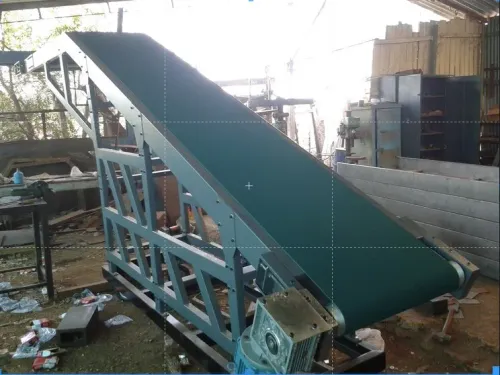
| powered belt conveyor | Bags, shrink-wrapped cases, trays, open or unstable loads; controlled orientation and incline | Belt friction, speed, and curvature limit capacity |
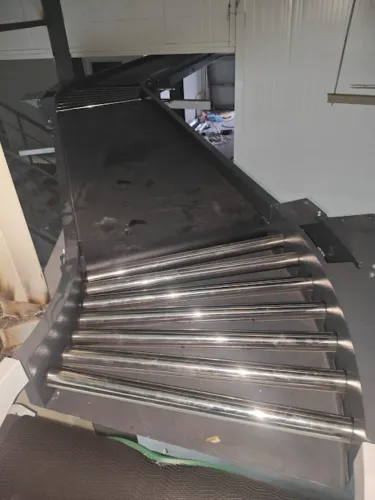
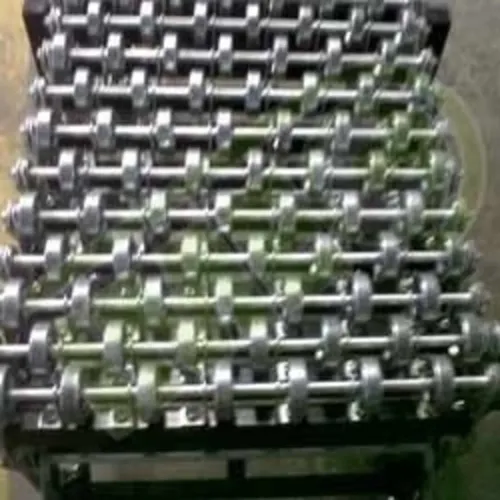
| powered roller conveyor | Rigid, flat-bottomed cases and trays that must merge or rotate | Poor contact with soft bags, narrow bases, or uneven loads |
| free-roller | Rigid products moving short distances with a controlled slope | Products can stop, slide, bunch, or roll unpredictably |
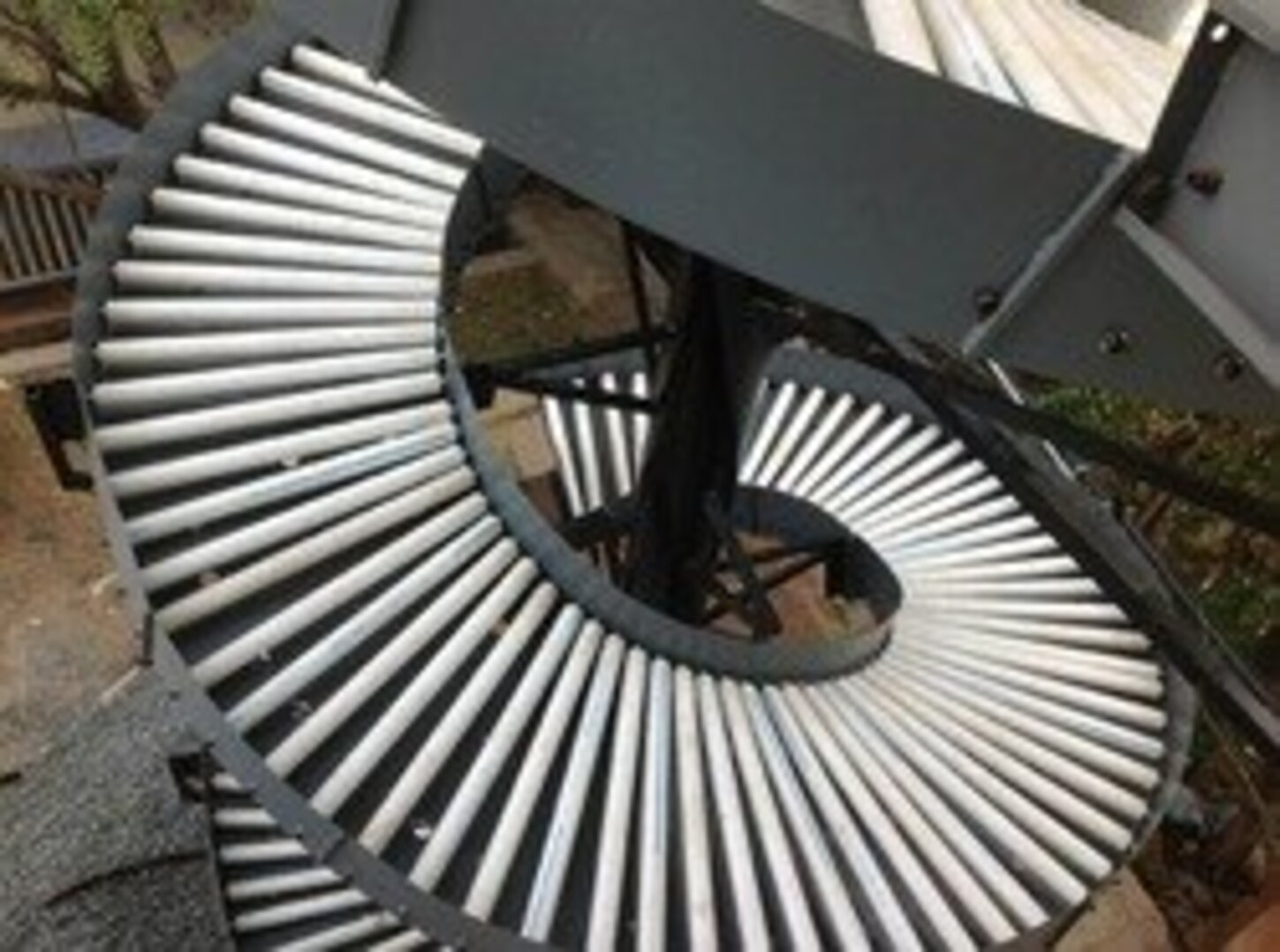
| gravity spiral conveyor | Downward flow of stable, rigid loads | Needs braking and containment; unsuitable for tipping or runaway products |
A powered belt conveyor handles bags better than rollers, while flights, pockets, side containment, or a lower incline prevent products from sliding, rolling, or tipping. Check the tightest-radius section: nominal belt width is not usable product width after side guards, product clearance, curvature, and inner and outer radii consume the loading envelope.
For wire-mesh belt selection, compare the smallest product dimension with the mesh opening and confirm belt sag and support spacing. A small or soft product can snag, wedge, deform, or fall through. Open mesh improves drainage, drying, cooling, heat transfer, and washdown, but joints, welds, sprockets, belt edges, supports, and inaccessible undersides still determine cleanability.
Specify materials and protection for product temperature and washdown chemicals before selecting the belt.
Prove capacity, direction, and product control under real operating conditions
Start with a spiral conveyor capacity calculation, not a catalogue speed. For discrete products, the upper bound is throughput ≈ belt speed ÷ product pitch, where product pitch equals product length plus the required gap.
Reduce that figure for usable belt length, the number of products carried at once, accumulation, loading pattern, product rotation, merges, and the discharge rate.
1. Upward conveying needs torque for payload elevation as well as belt movement. Confirm that the drive maintains the required rate during loading and startup, not only after the spiral reaches speed.
2. Downward conveying needs gravity descent control: controlled speed, a conveyor backstop and braking, and protection against runaway loads during power failure. Test the full descending payload, because gravity can accelerate products beyond the receiving conveyor’s safe rate.
3. Reversible operation needs controls, belt tracking, drive torque, and braking designed for both directions. A drive rated for forward travel alone does not prove safe reverse operation.
Size the motor for payload, belt-to-support friction, curve resistance, startup acceleration, accumulation, and jam-clearing loads; empty-belt running proves very little. Test every transfer for drop height, relative belt speed, product orientation, dead-plate length, and receiving-conveyor direction.
A small gap or speed mismatch can rotate, tip, crush, or jam products, turning a compact route into the bottleneck.
Keep the compact layout serviceable and safe
A spiral conveyor specification must define the operating envelope before anyone claims floor-space savings. Require these details:
- Product length, width, height, weight range, usable belt width, pitch, elevation gain, speed range, capacity calculation, allowable accumulation, belt support, and transfer details.
- Drive torque for loaded startup and jam clearing, take-up arrangement, sprocket engagement, belt tracking method, and power-failure behaviour.
Reserve spiral conveyor maintenance access for belt removal, cleaning, inspection, lubrication where applicable, drive and take-up adjustment, and guarding removal. Do not place the frame against a wall solely to reduce the footprint; blocked access turns a compact layout into prolonged downtime.
Specify how the design handles uneven loading, contaminated support surfaces, shaft misalignment, thermal expansion, edge wear, belt wandering, and guard interference. Confirm that belt tracking and take-up remain adjustable after installation, with support surfaces and sprockets aligned across the full route.
Base the ISO 12100 risk assessment on the actual layout. Guard nip points at sprockets and rollers, belt-edge entanglement zones, falling-product paths, accessible moving belt surfaces, and unexpected restart after a power interruption.
When comparing a proposal from Integrated Conveyors And Pacline Automation Technologies with another supplier, request a dimensioned general-arrangement drawing, product test results, capacity assumptions, maintenance clearances, and power-failure behaviour. Reject generic speed or load claims that omit product pitch, loading pattern, and allowable accumulation.
Related products
 | SPIRAL MS SPIRAL FREE ROLLER CONVRYOR The Spiral Conveyor is a compact, high-efficiency vertical transport system designed to move products between different elevations while occupying... View product → |
 | SPIRAL CONVEYOR The Powered Spiral Conveyor is an advanced continuous-flow conveyor system designed to move products vertically in a compact footprint. View product → |
Frequently asked questions
How do you calculate a spiral conveyor’s real footprint?
Measure the spiral’s outside diameter, entry and discharge straight sections, guarding, controls, transfer zones, and service clearances. Compare that complete plan area with a ramp or lift installation, including their loading and unloading space.
What building measurements are needed for a spiral conveyor between levels?
Record the finished slab-to-slab elevation, available openings, entry and discharge elevations, product travel direction, ceiling height, floor loading limits, and access for installation and maintenance.
How do you match spiral conveyor construction to the product?
Check product dimensions, weight, centre of gravity, surface, temperature, moisture, packaging, and allowable incline. Use those details to select the belt or chain, wear surfaces, side guides, frame materials, and containment.
How can you prove a spiral conveyor will control products in operation?
Test the required throughput, speed, product spacing, accumulation, reversing or diverting direction, transfers, starts, stops, and emergency conditions with representative products.
Related products
 | Conveyor Spiral Conveyor is a compact, high-performance material handling system designed to transport products vertically while minimizing floor space. View product → |
 | CONVEYOR Smart, Space-Saving Vertical Material Handling Solution Product Description: The Spiral Conveyor is designed for efficient vertical transportation of... View product → |
 | Conveyor SPIRAL GRAVITY FREE FLOW ROLLER CONVEYOR 🔷 SPIRAL GRAVITY FREE FLOW ROLLER CONVEYOR Description: The Spiral Gravity Free Flow Roller Conveyor is a space-saving and cost-effective solution... View product → |
 | Conveyor 🔷 SPIRAL ROLLER CONVEYOR Description: The Spiral Roller Conveyor is a vertical material handling system designed to move cartons, boxes, totes, and... View product → |