A carton moves on skate wheels only when its weight, package base, conveyor slope, and wheel condition create enough forward force to overcome rolling resistance. By the end, you will be able to specify wheel spacing and conveyor width, set a workable layout, control speed and transfers, and decide when another conveyor type is safer or more predictable.
Key takeaways
- Use a slight slope or manual push to start carton movement.
- Choose wheel pitch so each carton contacts at least three wheels.
- Test carton bottoms, weight, and rigidity before selecting skate wheels.
- Add stops, brakes, or transfer devices where uncontrolled speed creates risk.
How a Carton Moves Without a Motor
A carton moves because its weight is carried by several small wheels rather than a continuous belt. On a level gravity skate wheel conveyor, the weight produces no forward force, so an operator push starts the carton movement. Once rolling, the carton continues only while the force from its motion exceeds rolling resistance.
A controlled slope supplies that force by giving the carton’s weight a downhill component. The slope must match the carton and its contact surface: a rigid, flat bottom rolls more easily than a soft or damaged one, while dirty wheels or a rough bearing can stop travel.
Too little slope leaves cartons stranded; too much creates runaway loads.
Keep sections aligned and at the same elevation so a carton does not catch at a joint. Lock and brace portable stands before loading, then use a stop or end restraint where the route finishes. Remove obstructions from wheel paths, and inspect wheels that turn slowly or sit below their neighbours.
A motorless line saves electrical controls, but it does not provide fixed speed, automatic release timing, or protection from pinch points at stops and transfers. Keep hands clear while an operator push starts a carton, and never stand downhill of an uncontrolled load.
How to Set the Slope, Wheel Pitch, and Conveyor Size
The conveyor incline must be steep enough for the lightest carton to overcome rolling resistance, but not so steep that heavier cartons accelerate into stops. Start with the shallowest slope that moves every package during a loaded trial, then test with clean and contaminated wheels, different carton bottoms, and the desired loading rate.
| Layout condition | Slope decision | Main risk controlled |
|---|---|---|
| Level section | Use only where an operator supplies the initial push and continued movement is acceptable | Cartons stop between pushes |
| Short downhill run | Increase the conveyor incline until the lightest package travels without stalling | Heavy cartons running too fast |
| Mixed weights or bottoms | Choose the slope from the least mobile package, then add a brake, stop, or speed-control point | Light cartons stall or heavy cartons collide |
Set wheel pitch from the shortest package length, not the average. Keep at least three wheels under the carton at every point; as a starting rule, wheel pitch should not exceed one-third of the shortest package length. A short carton spanning only two wheels can rock, bridge the gap, or overload one wheel.
Size the width so the package engages several wheel rows while leaving little side-to-side clearance. Excess clearance permits yaw, especially through curves, so add side guides when orientation matters. Check the individual wheel, axle, frame, and support ratings against the actual weight distribution, not just total carton weight.
A crushed corner or soft bottom can concentrate the load and overload a wheel even when the carton is within the conveyor’s stated capacity.
Which Packages Run Reliably on Skate Wheels?
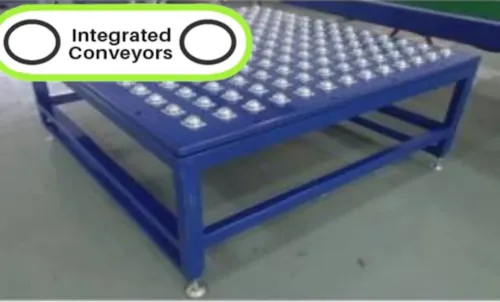
A package is a good skate-wheel candidate when its base is rigid, reasonably flat, and wide enough to rest on several wheel rows. Corrugated cartons, rigid totes, and plastic bins usually meet that test when their bottoms are intact and the load stays centered.
| Package condition | Reliability | What to check |
|---|---|---|
| Rigid, flat-bottom carton or tote | High | Keep the base intact and the weight spread across the bottom |
| Uneven or partly crushed carton | Low | A corner can catch between wheels and stop the load |
| Soft-bottom packages, bags, or loose shrink wrap | Low | Flexible material sags into wheel gaps and drags |
| Long, narrow, very small, or irregular packages | Low | Confirm stable tracking and continuous wheel contact |
Weight alone does not determine suitability. Check the rating of each wheel, axle, frame, and support; a heavy carton can overload individual wheels when an uneven bottom leaves only two contact points.
Keep at least three skate wheels beneath the package at all times, and set wheel pitch from the shortest carton, not the average carton.
The package must also engage several wheel rows across its width. Excessive side clearance lets it yaw, while too little width leaves the edges unsupported; add side guides when orientation matters. Damaged corners, protruding straps, and undersides that touch the frame are disqualifiers, even when the package is otherwise light.
How to Control Speed, Accumulation, and Transfer Points
Prevent runaway cartons by controlling speed in stages, not by relying on one continuous incline. Use an inclined feed to start movement, a level or low-slope section to reduce speed, and a controlled discharge at the receiving point.
1. Measure the discharge speed with the heaviest and lightest cartons. Install brake rollers or other friction devices before the receiving area when cartons accelerate, collide, or damage labels. Clean wheels and inspect bearings, axles, tape, dust, and crushed carton material because friction changes can create unexpected stop points.
2. Create accumulation zones with enough length for cartons to queue without reaching the incline. Fit end stops or metering gates at the discharge, and release one carton only when the downstream position is clear. A powered take-away is the safer choice when the receiving conveyor cannot accept a free-running load.
3. Install side guides where cartons must stay square through curves, stops, hinges, or transfers. Set the guides close enough to prevent yaw without rubbing the carton; excessive clearance lets corners enter gaps and causes jams.
4. Inspect every transfer for equal heights, aligned side frames, tight gaps, and matching wheel pitch. A carton flap can catch at a hinge or dead spot even when both conveyor sections carry the load rating.
5. Lock and brace portable stands before loading. Keep hands away from pinch points at end stops, transfer plates, hinges, and adjoining sections, and never release a carton until the unloading area is clear. Test the setup empty, then with representative cartons.
When Skate Wheels Are the Right Choice—and When They Are Not
Choose skate wheels for a short, mostly downhill or hand-assisted route carrying rigid cartons with predictable bottoms and no exact spacing requirement. Reject them when the route must climb, meter individual packages, bridge wide gaps, or handle soft, irregular, or very small loads.
| Option | Best fit | Choose another system when |
|---|---|---|
| Skate wheels | Short transfers, shipping lanes, and accumulation with stable cartons | Loads rock, snag, or need controlled speed |
| Gravity roller conveyor | Heavier cartons and totes with broad, rigid bases | Small packages cannot stay on several rollers |
| Powered roller conveyor | Uphill travel, controlled spacing, and automatic starts and stops | The route is simple, downhill, and throughput is modest |
| Belt conveyor | Bags, soft-bottom packages, inclines, and continuous contact | You need low-cost gravity movement with minimal drive equipment |
| Pallet conveyor | Pallets, skids, and heavy unit loads | The route carries cartons or small totes |
| Flexible conveyor equipment | Temporary loading and unloading points that change position | You need fixed alignment, repeatable speed, or high throughput |
Compare the smallest, lightest, shortest package—not the average carton. Keep at least three wheels beneath it, then test the actual slope, wheel condition, contamination, and discharge speed; gravity provides no inherent speed control, so add brake sections, stops, or a powered take-away when collisions threaten.
For mixed carton bottoms, give Integrated Conveyors And Pacline Automation Technologies the smallest package dimensions and route profile to evaluate wheel pitch and transfer points, rather than selecting equipment from the nominal carton size.
Related products
 | Skate Wheel For Conveyors Fostered with vast industry experience and knowledge of this domain, we are engaged in presenting Gravity Skate Wheel Conveyors. View product → |
 | Conveyor 🔷 STEEL SKATE WHEEL CONVEYOR Description: The Steel Skate Wheel Conveyor is a lightweight, cost-effective solution for manual or gravity-based... View product → |
Frequently asked questions
How does a carton move on a gravity skate wheel conveyor?
The carton’s weight rests on multiple wheels. On a level conveyor, an operator must push it; on a sloped conveyor, gravity provides the forward force.
How should you set the slope, wheel pitch, and conveyor size?
Set enough slope to overcome rolling resistance without letting cartons accelerate dangerously. Space wheels so the carton contacts at least three at all times, and size the frame for the carton’s width and load.
Which packages run reliably on skate wheels?
Rigid cartons with flat, clean, firm bottoms run best. Flexible packs, damaged boxes, narrow loads, and cartons with protruding seams or uneven bases need testing or another conveyor surface.
How do you control speed, accumulation, and transfer points?
Use stops, brakes, flow-control sections, side guides, and properly aligned transfers. Do not rely on friction alone when cartons could collide or fall.
When are skate wheel conveyors the wrong choice?
Choose another system when loads need powered movement, precise spacing, controlled accumulation, frequent elevation changes, or support for soft and irregular package bottoms.