Choosing a chain conveyor starts with the load’s underside, centre of gravity, travel path and operating cycle—not its weight alone. By the end, you will be able to screen the load, compare chain arrangements with other conveyor types, identify the engineering inputs that control capacity, and spot conditions that call for a different system.
Key takeaways
- Use chain conveyors for heavy, hot, sharp, oily, wet or abrasive loads.
- Match the chain arrangement to the load base, dimensions and centre of gravity.
- Rate capacity for acceleration, accumulation, transfers and uneven loading—not weight alone.
- Plan transfers, guarding, lubrication and maintenance access before finalising the layout.
Start With the Load and the Operating Duty
A chain conveyor is a suitable starting point when the load is heavy, hot, sharp-edged, oily, wet, abrasive, or difficult to move with a belt. Chain conveyor selection must consider more than load mass: load dimensions and centre of gravity determine tipping, skewing, contact pressure, and whether the underside can span the selected chain arrangement.
Use these inputs to screen the application:
- Load mass, including the heaviest accumulated or jammed condition
- Load dimensions, centre of gravity, underside profile, and any unstable overhang
- Required speed, throughput, indexing accuracy, accumulation time, incline, and duty cycle
- Loading impact, stop-start frequency, and the need for positive engagement
- Exposure to heat, oil, water, abrasive dust, sharp edges, or corrosive materials
| Condition | Why chain suits it | What to verify |
|---|---|---|
| Heavy unit loads | Supports concentrated weight without belt stretching | Strand count, allowable chain pull, frame and support spacing |
| Hot, wet, oily, or abrasive loads | Tolerates environments that attack belt covers | Chain, sprocket, bearing, and lubrication compatibility |
| Indexing or controlled accumulation | Positive drive gives repeatable positioning | Backpressure, product contact, and transfer gaps |
| Long, uniform, high-throughput transport | Usually a weaker starting point than belt conveying | Choose belt when low resistance and a continuous surface dominate |
Do not approve a conveyor because its peak rating exceeds the product weight. Startup torque, impact loading, stalled-load torque, sprocket and shaft loads, and the heaviest credible accumulation condition can govern the motor, gearbox, coupling, chain, and frame. That is the core of heavy-duty material handling.
Match the Carrying Surface to the Load Base
Choose the carrying surface by how the load contacts the conveyor, not by product weight alone. A pallet with two strong runners suits two chain strands; a flexible tote with a sagging base does not. If the load bridges between supports, it can tip, scrape the frame or overload one strand.
| Option | Best load base | Main design check |
|---|---|---|
| Chain strands | Pallet runners, skids and rigid crossbars | Align strands with load-bearing runners; add strands or a deck when the base flexes |
| Metal slat conveyor | Flat-bottomed crates, cartons, drums and small-footprint parts | Use enough slat width and support to prevent tipping, skewing and point loading |
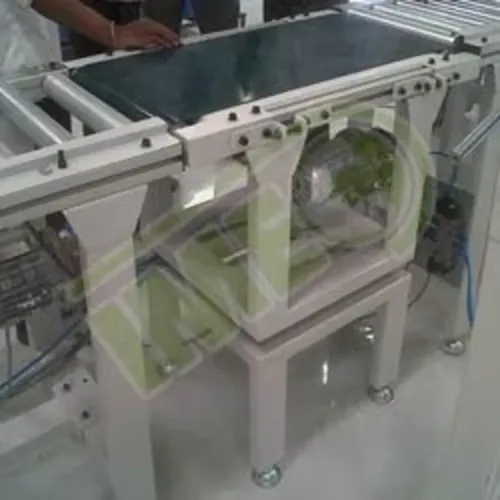
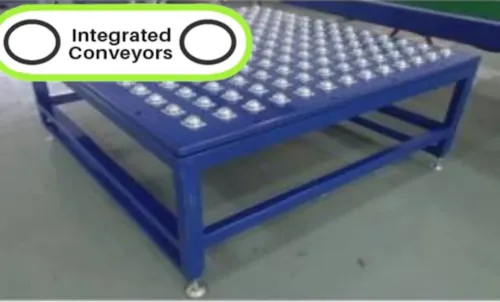
| Chain-driven rollers | Rigid pallets, steel frames and flat-bottomed unit loads needing accumulation | Keep the base rigid and level; check roller spacing so the load always contacts several rollers |
| Mesh | Parts needing drainage, airflow or reduced contact area | Prevent small feet, protrusions and irregular castings from catching in the openings |
A pallet conveyor needs strand spacing matched to the pallet runners, not simply a larger chain. Long pallets may need three or more strands, side guides, wear strips or a solid intermediate deck. Flexible containers need broad support; increasing chain size does not correct a poor contact pattern.
Use slats or rollers when the load needs a more continuous base or controlled accumulation. Use mesh for airflow or washdown access, but add fixtures or crossbars for irregular parts. Check every support point through transfers and stops, where tipping and concentrated impact expose weak underside support.
Check Capacity Beyond the Product Weight
Capacity is proven by the worst credible load, not the average product weight. Calculate chain pull for startup, acceleration, incline, friction, impact loading and the heaviest accumulation or jam condition, then compare it with the allowable chain pull.
| Check | Design input | Failure if missed |
|---|---|---|
| Motor torque | Startup, acceleration and stalled-load torque at the gearbox output | The motor cannot start a loaded conveyor, or the gearbox overheats |
| Sprocket size | Tooth load, shaft torque, chain articulation and speed | Chain wear, poor engagement or tooth failure |
| Chain strands | Load sharing, attachment forces and uneven product loading | One strand overloads when the load is skewed |
| Frame capacity | Product, chain, impact and drive-reaction loads | The frame bends, twists or misaligns the chain |
| Support spacing | Chain weight, product weight and allowable sag | The chain drags, increases pull or leaves the sprocket |
Before approving the design, physically check these conditions:
- Stop the heaviest load within the required distance without rollback, product shift or excessive chain tension.
- Check shaft, key, coupling and bearing ratings against startup and jam torque, not just running torque.
- Verify the return run has wear strips, rollers or rails that support chain weight, debris and operating temperature.
- Provide a defined take-up range for chain wear and thermal expansion; excessive tension overloads bearings, while slack causes shock loading and disengagement.
For an incline, verify product friction, attachment geometry, loading pattern and rollback control with the actual load. A published angle limit means little without those details. Gearbox braking or a separate backstop is essential where a stopped load could run backward.
Compare Chain With Belt, Roller, Apron and Drag Conveyors
Choose chain when the load would cut, scorch, soak, abrade or stretch a belt, and when positive engagement matters more than quiet, low-maintenance transport. Accept higher noise, lubrication, wear-point inspections and contact damage at sprockets, transfers and chain-to-product interfaces only when those risks are controlled by the load and duty.
| Option | Strength | Better alternative when |
|---|---|---|
| Chain conveyor | Handles heavy, hot, sharp-edged, oily or wet loads; carries inclines with suitable attachments and limits rollback. | Choose another type when the product needs gentle, quiet contact or frequent washdown. |
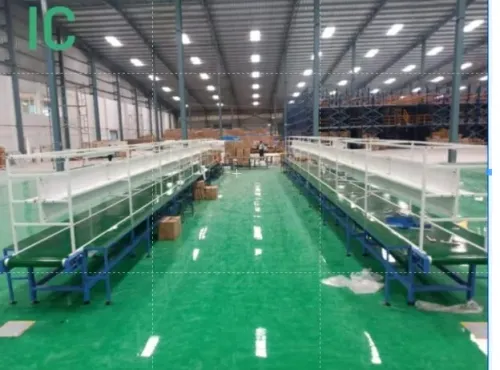
| Belt conveyor | Provides continuous, quiet support with few product contact points. | Use it for clean, stable loads and gentle handling; reject it when sharp edges, heat or oil will damage the belt. |
| Powered roller conveyor | Supports pallets and rigid-bottomed loads while allowing accumulation and transfers. | Choose it when the underside is flat and speed control matters; chain suits irregular bases that rollers cannot support. |
| Gravity roller conveyor | Uses no drive power and works for cartons or pallets on a controlled slope. | Avoid it for heavy loads needing powered starts, elevation, precise spacing or level movement. |
| Apron conveyor | Overlapping pans support large, dense, sharp or hot bulk solids with less leakage than open flights. | Avoid it for fragile products, fine powders needing low leakage or easy washdown. |
| Drag conveyor | Encloses bulk solids and controls dust better than an open belt. | Avoid it for sticky material that builds up and plugs, or abrasive material that accelerates trough and flight wear. |
A belt conveyor comparison is incomplete without checking transfer impact and cleanability, not just rated capacity. Integrated Conveyors And Pacline Automation Technologies can use those inputs to distinguish a roller-chain strand, pallet chain, apron or drag design; “chain” alone does not specify sprocket loads, shaft torque, articulation or frame requirements.
Related products
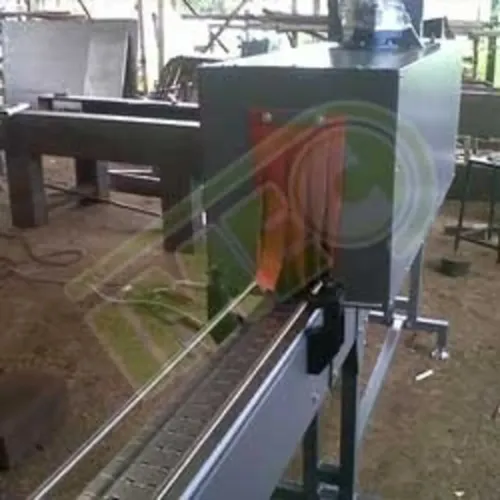
 | CHAIN CONVEYOR Heavy Duty Chain Conveyor is built for abuse. It moves pallets, drums, castings, engines, crates, and steel components without flinching. View product → |
 | Conveyor The Chain Conveyor is designed for moving heavy and bulky materials with ease, especially in industrial and manufacturing environments. View product → |
Design Transfers, Accumulation and Safe Maintenance Into the Layout
Prevent failures by treating every transfer, stopping point and service access as part of the conveyor design, not as additions after installation. Keep the chain path level through a chain-to-roller transfer, match the two conveyor speeds, and support the load before its centre of gravity crosses the gap.
A pop-up transfer needs clearance for its raised mechanism; a turntable and lift gate need interlocks that stop conveying before movement begins.
Use these layout checks:
- Provide side guides or fixtures where loads can skew, tip or contact sprockets.
- Specify zero-pressure accumulation with independently controlled zones; a continuous chain normally creates backpressure that crushes cartons, destabilises pallets and overloads the drive.
- Leave access to chain tensioners, sprockets, bearings, oil points and the return run without dismantling the frame.
- Fit conveyor guarding around chains, sprockets, shafts, pinch points and transfer mechanisms, with inspection doors secured against unexpected opening.
- Install emergency-stop pull cords or buttons where a person can reach the conveyor, then isolate and lock out electrical and stored mechanical energy before service.
Do not place a guard where it blocks routine inspection while leaving a reachable nip point elsewhere. Mark lubrication points and chain-tension settings, and provide enough clearance to remove a chain or shaft. Inspect chain elongation, sprocket tooth wear, loose attachments, bent slats and transfer impact on a scheduled basis.
A small gap that collects debris can become a jam; a neglected return strand can damage the frame before the motor overload trips.
Frequently asked questions
When are chain conveyors suitable for heavy-duty material handling?
Choose them for heavy, hot, sharp-edged, oily, wet, abrasive or difficult-to-belt loads when the product can rest on the selected chain arrangement.
How do you match the carrying surface to the load?
Check the load base, dimensions, centre of gravity and underside span to prevent tipping, skewing and excessive contact pressure.
What should capacity calculations include besides product weight?
Include acceleration, starts and stops, accumulation, transfers, friction, uneven loading and the combined load on chains, sprockets and drive components.
How should chain conveyors be compared with belt, roller, apron and drag conveyors?
Compare each option against load temperature, surface condition, required support, accumulation, transfer needs, cleanliness, noise and maintenance access.
Related products
 | Conveyor PALLET TRANSFER CHAIN CONVEYOR Description: The Pallet Transfer Chain Conveyor is designed for heavy-duty pallet handling in industrial environments. View product → |
 | CHAIN CONVEYOR The Metal Slat Chain Conveyor is a robust and heavy-duty conveying system designed for transporting a wide range of materials — from industrial... View product → |
 | Conveyor CHAIN DRIVEN LIVE ROLLER CONVEYOR (CDLR) Product Description: The Chain Driven Live Roller (CDLR) Conveyor is a rugged and reliable material handling solution specifically designed... View product → |