A belt that carries the required tonnes per hour can still fail if the product slips, falls through an opening, overheats the belt, or arrives at transfers with too much impact. By defining the product, calculating effective tension, checking the operating environment, and validating the conveyor geometry, you can compare belt options against the actual duty rather than a vague capacity claim.
Key takeaways
- Match flat belts to cartons and cleated belts to loose bulk solids.
- Calculate product weight, loading pattern, speed and duty cycle before capacity.
- Specify belt materials for temperature, chemicals, moisture and cleaning methods.
- Check incline, transfer gaps and belt speed against product stability and damage risk.
Match the belt construction to the product
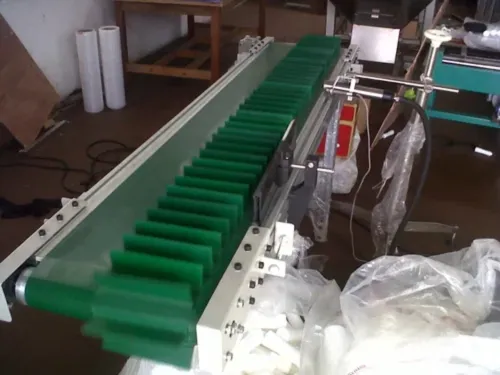
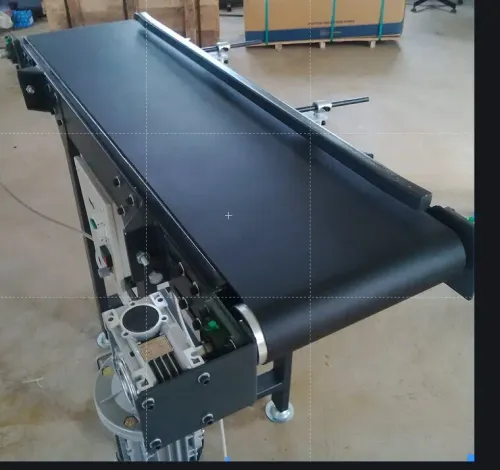
Conveyor belt selection by product type starts with contact, not throughput. Cartons and oriented bags need a flat, low-slip surface; fragile goods need soft support and controlled transfers. Loose bulk solids need cleats, flights, pockets, and sidewalls sized to the particle size.
Wet foods need drainage and clean release; sharp, hot, and oily parts demand abrasion, heat, and oil resistance.
| Construction | Best fit | Main failure or limitation |
|---|---|---|
| PVC conveyor belt | Cartons, bags, dry packaged goods | Oil swelling, heat damage, poor release |
| PU conveyor belt | Wet foods, fragile products, hygienic lines | Hydrolysis or coating loss under harsh washdown |
| Rubber conveyor belt | Sharp parts, abrasive bulk solids, heavy loads | Product marking and poor oil compatibility |
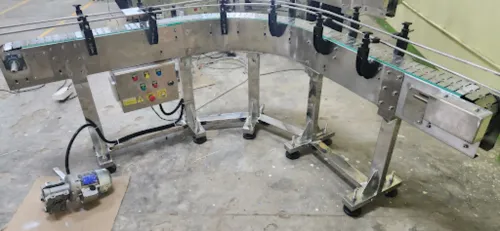
| Modular plastic | Washdown lines, wet foods, positive sprocket drive | Hinge wear, product marking, poor release |
| Wire mesh | Hot parts, drying, washing, air circulation | Mesh loss, rod damage, and small-item loss |
| Metal belt | Very hot or sharp parts | Heavy construction, marking, and transfer impact |
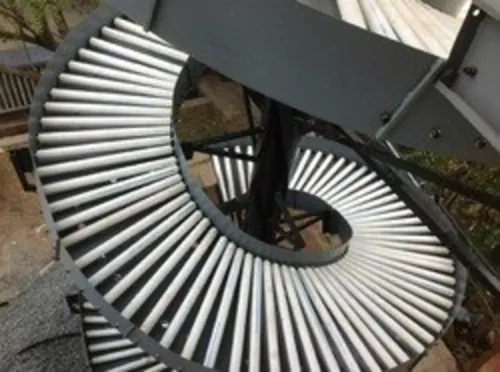
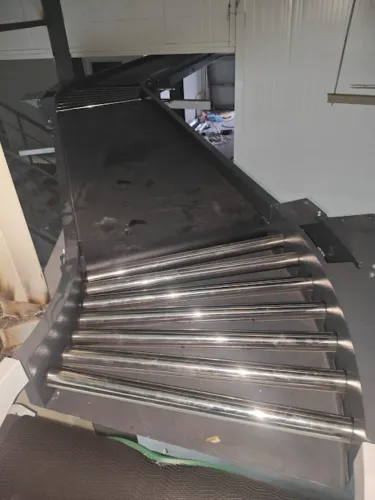
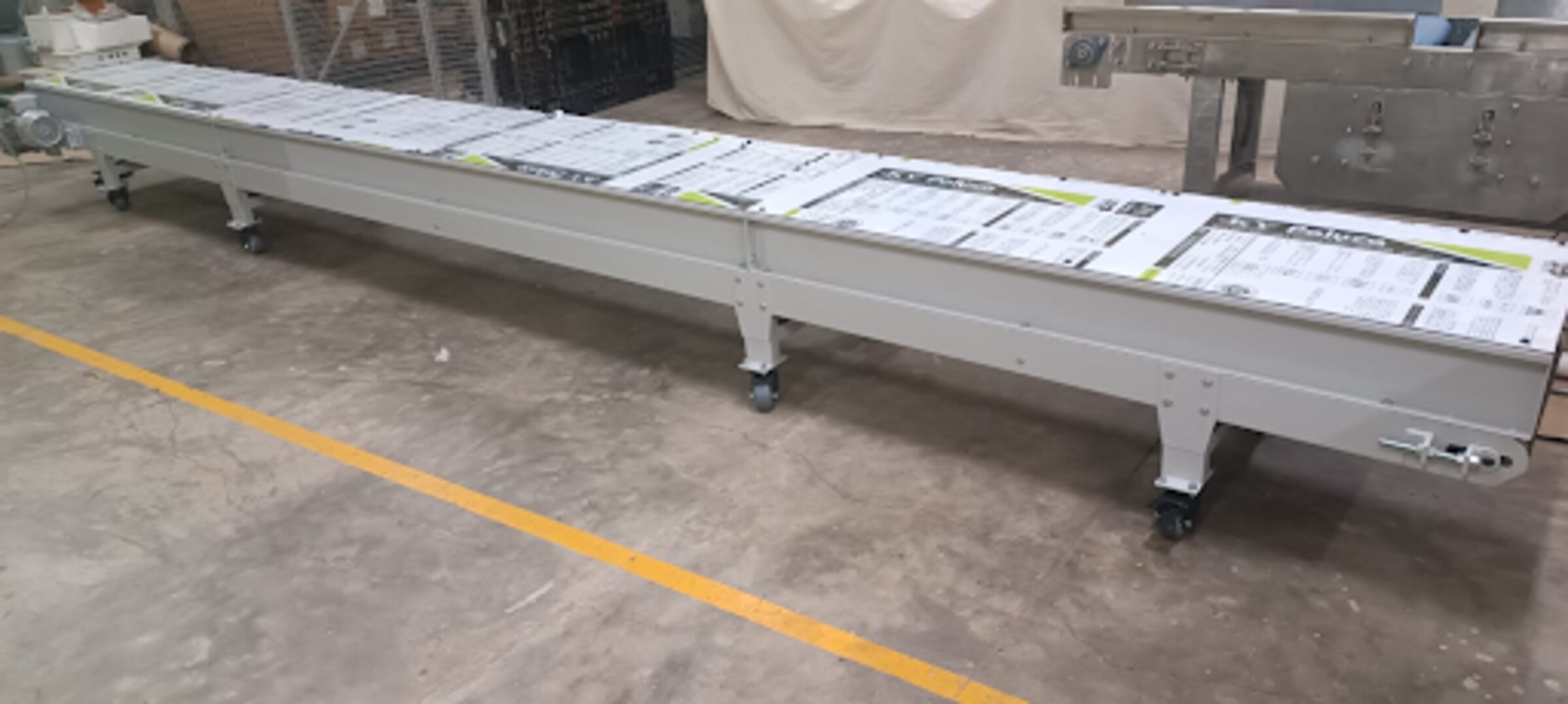
A flat belt suits stable cartons; a roller conveyor suits rigid cartons that need accumulation. Use a cleated incline conveyor or Z conveyor for loose solids, bags, or cartons moving between elevations. Use a slat-chain conveyor for rigid containers that must remain upright.
Set flight height just above the product’s centre of gravity, and choose pitch and sidewalls to prevent rollback without trapping the product.
Open mesh improves drainage and hot-air penetration but reduces support and can deform soft food. Reduce transfer drop height because impact can damage crimps, rods, links, or polymer covers. Check pulley diameter, sprocket pitch, rod diameter, and edge construction together; positive-drive mesh still needs synchronized sprockets and accurate alignment.
Calculate the real conveyor duty before checking capacity
1. Calculate total moving load, not product mass alone. Add conveyed load per metre to belt weight, then multiply by the loaded length.
Record any point load from a single heavy item and the impact load from a drop at the feed; a sharp part dropped onto wire mesh or a polymer cover can damage the belt before average capacity is reached.
2. Determine effective belt tension from resistance. Include friction at idlers and pulleys, scraper and skirt-seal drag, acceleration, and elevation gain; for a decline, include braking or rollback forces. Starting conditions matter: a loaded belt starting from rest demands more tension than one running steadily.
3. Do not equate throughput with belt rating or motor power. Two conveyors moving the same tonnes per hour can need different drives because their lengths, lifts, speeds, belt weights, transfer drops, loading patterns, and starting methods differ. Reduce impact with a controlled transfer or lower drop height before selecting a heavier belt.
4. Convert every supplier figure before comparing it. If a quotation says 20 kg per foot, ask whether that means distributed live load, maximum load at one point, throughput over time, or allowable belt tension.
Multiply a distributed figure by the loaded conveyor length, then check loading zones, inclination, and transfer points against the actual layout.
Request the belt’s permitted working-tension limit, splice efficiency, and safety margin for starting loads, impact, mistracking, temperature, chemical degradation, and scraper drag. Breaking strength is the pull that causes failure, not a usable operating limit; treating it as one causes elongation or belt failure.
Select materials for temperature, chemicals and hygiene
Check the conveyor belt temperature rating against continuous product temperature, peak temperature, steam-cleaning temperature, thermal shock, and hot alkaline wash temperature. Check the drive, supports, fasteners, and splice separately; a high-temperature belt can still fail when a cold belt is hit by steam or a hot product.
Chemical compatibility depends on more than the chemical name. Give the belt supplier:
- Chemical concentration and temperature
- Contact or soak time
- Cleaning frequency and rinse method
- Exposure to moisture, oil, dust, abrasion, ultraviolet light, static electricity, and corrosive atmospheres
Watch for swelling, embrittlement, hydrolysis, coating loss, cracking, and softening. Repeated caustic sanitation or oxidizing disinfectant exposure can destroy a polymer that tolerates the conveyed product.
Food-contact compliance does not prove hygienic conveyor design.
| Check | What it proves | What it does not prove |
|---|---|---|
| FDA or EU food-contact suitability | The material is suitable for stated food-contact conditions | That the complete conveyor is cleanable |
| Hygienic conveyor design | Drainage, accessible surfaces, smooth welds, cleanability, and no harborage points | That the belt material is legally suitable for food contact |
For EU food lines, request a declaration of compliance for the intended conditions under Regulation (EC) No. 1935/2004, plus evidence of good manufacturing practice under Regulation (EC) No. 2023/2006. Do not accept “food grade” alone. For pharmaceutical lines, specify drainage, weld quality, accessible surfaces, and clean-down validation.
Check incline, speed and transfer geometry
A belt that runs fast enough for throughput can still fail the process by shortening heating, cooling, drying, inspection, or weighing time. Select belt speed from both mass flow and required residence time; increasing speed preserves throughput only when the loading cross-section increases, and it also raises tumbling, transfer impact, dust, and tracking sensitivity.
Do not choose a conveyor incline angle from a universal table. The usable conveyor incline angle depends on coefficient of friction, moisture, particle shape, centre of gravity, acceleration, and belt texture. Cleats, flights, sidewalls, and pockets prevent rollback or sliding, but can trap, mark, or deform fragile goods.
Check the geometry before approving the belt:
- Compare product dimensions with the smallest wire-mesh aperture, transfer gaps, loading cross-section, and belt support spacing. A product can fall through edge-on or after rotating.
- Specify a transfer nose bar that limits sag and impact without pinching the product; reduce drop height where sharp or fragile parts land.
- Confirm the minimum pulley diameter against belt stiffness, splice, coating, transverse rod, edge construction, sprocket pitch, and rod diameter.
- For positive-drive mesh belts, keep sprockets synchronized and verify tracking, rod alignment, tooth engagement, and frame squareness. Bent rods, unequal loading, or worn teeth create edge wear and wandering.
- Balance open mesh against drainage and airflow: larger openings improve washing and hot-air penetration but reduce support and increase marking, deformation, or small-item loss.
- Test the loaded belt at acceleration and operating speed to expose rollback, tumbling, trapping, transfer impact, and product fall.
Turn the duty into a supplier specification
Put every operating variable into the conveyor supplier specification so competing quotations describe the same duty, not different interpretations of “capacity.”
- Product: dimensions, shape, orientation, fragile or sharp surfaces, mass range, and whether pieces arrive individually or in groups.
- Duty: throughput, load distribution, maximum point load, drop height, belt speed, required residence time, incline or decline angle, and loading cross-section.
- Construction: wire-mesh conveyor belt aperture, belt opening, support spacing, pulley or sprocket diameter, tracking method, splice or rod construction, and edge retention.
- Environment: continuous and peak temperature profile, moisture, dust, oil, washdown chemicals with concentration and temperature, hygiene requirement, and food-contact status.
- Drive: acceleration time, motor starting method, stopping method, and the required working-tension margin above calculated effective tension.
Ask the supplier to define capacity in writing. A figure in kg per foot could mean any of these:
| Meaning | What it measures | What you must request |
|---|---|---|
| Distributed live load | Product mass spread along the belt | Maximum load per metre and loading length |
| Throughput | Product moved per hour | Product mass, spacing, and belt speed used |
| Allowable tension | Belt pulling force | Permitted working tension and safety margin |
Request belt material data, temperature and chemical limits, a food-contact declaration where relevant, and test evidence for transfers or incline performance. For a custom conveyor system, Integrated Conveyors And Pacline Automation Technologies can evaluate the belt, frame, drive, transfer, and loading method as one duty rather than sizing each component separately.
Related products
 | Features of Modular Belt Conveyors For transporting piece goods without specific requirements regarding the product’s position, orientation or the... View product → |
 | Conveyor 🔷 FLAT BELT CONVEYOR Description: The Flat Belt Conveyor is one of the most commonly used and versatile material handling systems, ideal for... View product → |
Frequently asked questions
How do I match conveyor belt construction to the product?
Use flat, low-slip surfaces for cartons and oriented bags; choose soft support for fragile goods and cleats, flights, pockets or sidewalls for loose bulk solids.
What conveyor duty details should I calculate before selecting capacity?
Calculate product weight, loading pattern, throughput, belt speed, conveyor length, incline, duty cycle and starting conditions before comparing rated capacity.
Which belt materials suit temperature, chemicals and hygiene requirements?
Select the belt cover and construction against the actual temperature range, chemicals, moisture exposure, cleaning agents and hygiene controls in your process.
What incline, speed and transfer details affect belt selection?
Check product stability at the incline, belt speed against product handling needs, transfer gaps, pulley diameters and the geometry of every handoff.
Related products
 | BELT CONVEYOR The Sleek Belt Conveyor is a compact and efficient material handling solution designed for smooth and continuous product movement in industrial... View product → |
 | Inclined Belt Conveyor Z type belt Conveyor is very well suited for a broad range of free flowing products in the food, agriculture, pharmaceutical, cosmetic, chemical... View product → |
 | SLAT CHAIN CONVEYOR slat chain conveyor is a heavy-duty conveyor where metal or plastic slats are mounted on chains. View product → |