A conveyor specification built only around product weight and belt length will miss the conditions that cause jams, damage, contamination, and unsafe maintenance. By matching the product, process, route, controls, and operating environment to specific conveyor features, you can compare designs and identify the details a supplier must validate before fabrication.
Key takeaways
- Record product dimensions, weight, temperature, friction and group arrival pattern.
- Choose belt or conveying surface materials that protect the product and withstand the duty.
- Define accumulation, transfers and machine timing before fixing the conveyor route.
- Validate guarding, access, changeover space and the complete conveyor package.
Start with the product, process, and duty requirements
A conveyor specification starts with the product and the job it must perform, not with a preferred belt type. Record product length, width, height, weight, center of gravity, contact pressure limit, surface friction, temperature, and whether it arrives individually or in groups.
Then define required throughput, cycle rate, peak load, operating hours, and the percentage of time the conveyor runs loaded.
- Measure the available route, including conveyor length, elevation and height changes, curves, transfer points, maintenance access, and machine interfaces.
- State the required belt width, conveying speed, acceleration, indexing accuracy, load capacity, and allowable spacing between products.
- Describe accumulation: maximum quantity, permitted contact pressure, release sequence, and the response when a downstream machine stops.
- Identify oil, moisture, washdown chemicals, abrasive dust, sharp edges, static, and continuous or intermittent heat exposure.
- Give starting conditions, incline or decline angles, and the heaviest product pattern—not only the average load.
| Input | Translate it into | Failure if missed |
|---|---|---|
| Peak throughput | Belt speed, drive torque, and transfer capacity | Queues or product collisions |
| Product temperature | Belt alloy, frame expansion allowance, bearing protection, and tensioning method | Belt slack, misalignment, or seized bearings |
| Accumulation duty | Zone length, sensors, controls, and back-pressure limits | Scuffing, deformation, or collapsed packages |
| Load and incline | Gearbox size, shaft strength, traction, and braking | Stalled starts or uncontrolled rollback |
Select the drive for peak demand, friction, accumulation pressure, and acceleration—not average throughput. A variable-frequency drive controls speed; it cannot correct an undersized gearbox or inadequate belt tension.
Match the conveying surface and materials to the product
Choose the conveying surface by matching product stability, contact pressure, environment, and transfer risk—not by weight alone.
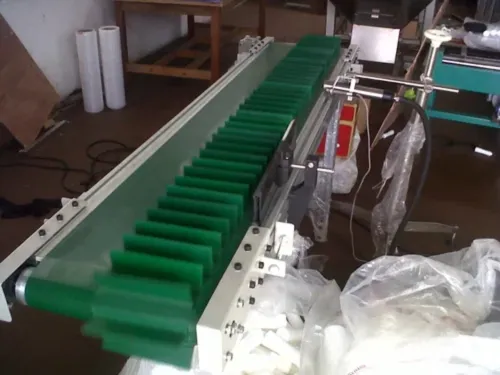
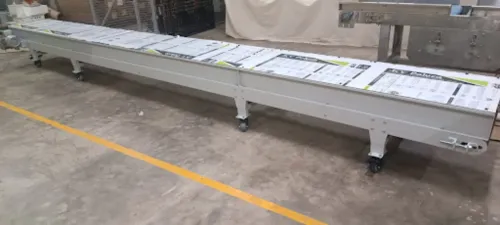
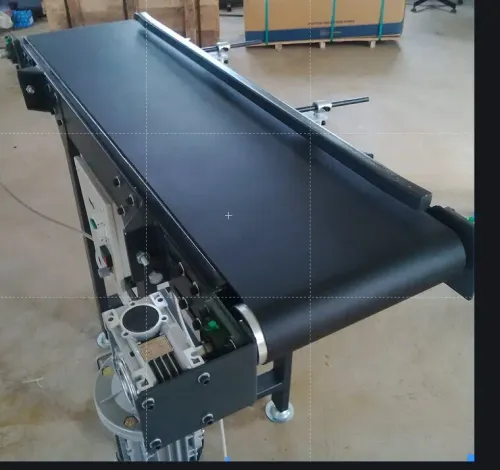
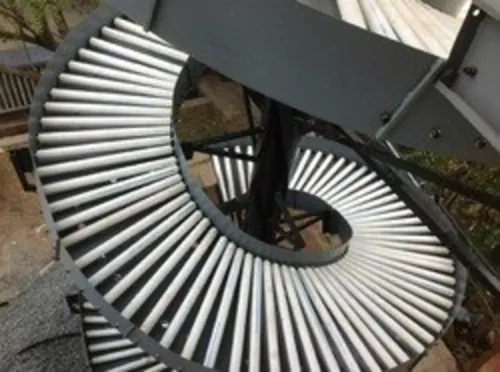
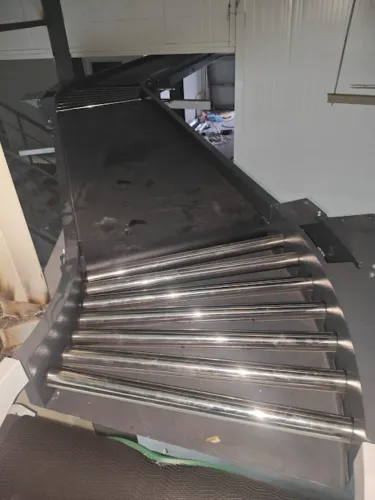
A flat belt suits stable cartons and sealed packs; a cleated belt holds products on inclines; a modular plastic belt handles washdown and quick component replacement; and a roller bed conveyor surface supports rigid loads that bridge rollers without tipping.
| Option | Best fit | Main limitation |
|---|---|---|
| Flat belt | Cartons, pouches, and products needing continuous support | Traps moisture and debris unless the belt and frame drain |
| Cleated belt | Inclines, elevation changes, and products needing retention | Cleats can catch flexible packs and complicate cleaning |
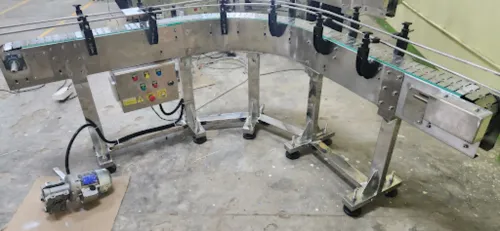
| Modular plastic belt | Washdown lines, curved routes, and varied product sizes | Hinges and sprockets need inspection for wear and contamination |
| Roller bed conveyor surface | Rigid cases and palletized loads | Small, soft, or unstable products can fall between rollers |
| Wire mesh conveyor belt material | Cooling, drying, frying, washing, and coating | Openings can catch small or flexible products |
Select materials for the actual contact conditions. Specify food contact compliance, washdown chemicals, chemical resistance, abrasion resistance, heat resistance, and static control where those hazards exist. Continuous high temperature requires an appropriate alloy or component package, expansion allowance, protected bearings, and tensioning that remains effective at operating temperature.
Check the smallest, least rigid product against the mesh opening, nosebar, sprocket, transfer plate, and belt-to-belt gap. A smaller transfer radius reduces the presented gap but increases belt flexing, fatigue, tracking sensitivity, and sprocket wear. Test the product at operating temperature, speed, and accumulation conditions before approving the surface.
Design product flow, accumulation, and machine synchronization
Set conveyor speed from the slowest machine cycle and the peak, not average, throughput. Maintain a defined product pitch with guides, lanes, or timing devices so orientation stays consistent at each handoff. A wide belt can simplify loading; multiple narrow lanes can improve spacing and alignment.
| Option | Control use | Design caution |
|---|---|---|
| fixed-speed drive | Constant flow between machines with matched cycle rates | It cannot correct changing demand or uneven spacing |
| variable-frequency drive | Adjusts speed and acceleration for changing rates | It does not fix an undersized gearbox, poor traction, or weak shaft |
| indexing conveyor | Advances products to fixed positions for filling, sealing, or robotic pickup | Confirm dwell time, stopping accuracy, and product stability |
| start-stop operation | Runs only when a downstream machine is ready | Repeated starts require adequate torque and controlled acceleration |
Use zero-pressure accumulation when contact could scuff, deform, or collapse the product. Specify individually controlled zones, a photoeye for each zone, and logic that stops upstream zones before a blocked handoff creates back pressure.
Write the controls specification around each machine interface:
- Define permissives, accumulation states, jam detection, restart behavior, and fault recovery in the PLC.
- Use an encoder for product tracking when belt slip or variable speed makes time-based tracking unreliable.
- Coordinate sorting, diverting, merging, weighing, and inspection with confirmed ready and complete signals.
- Exchange product identity, position, and fault data between the PLC, robot, filler, and sealer.
- Test dirty photoeyes, missed products, blocked zones, and a restart into an occupied transfer before approval.
Customize the route, transfers, retention, and access clearances
A restricted floor layout can use a curved conveyor to route around columns and equipment, while an incline conveyor and decline conveyor connect different elevations. A multi-level conveyor increases usable floor area, but reserve headroom for the product, guards, and operators; mark a clear access aisle and maintenance clearance before fixing the route.
Add a bypass where one machine needs servicing without stopping the main flow.
Choose retention to match the package’s center of gravity, friction, and allowable contact pressure:
- A cleat or flight supports products that slide on an incline, but it creates cleanout surfaces and can strike unstable packages.
- A sidewall contains loose or flexible products, but it can trap damaged packs at the edge.
- A timing pocket controls spacing through an elevation change, but it increases impact at loading and discharge.
- A vacuum hold-down stabilizes light products on a decline, but its seal, airflow, and perforated surface require cleaning and inspection.
Validate the selected method at maximum speed, acceleration, and fill level. At every transfer point, test the smallest, least rigid, and most irregular product. Check the gap at a nosebar, transfer plate, sprocket, and belt-to-belt junction; a stable product can still rotate, fall, or become trapped.
A small-diameter nosebar reduces the gap but increases belt flexing, tracking sensitivity, and wear, so match its radius to the mesh opening, belt construction, joint, and operating temperature.
Validate safety, changeover, and the complete conveyor package
Approve a conveyor only after a site survey, a documented risk assessment, and a factory acceptance test (FAT) that matches production conditions. Check machine guarding at every nip point, sprocket, transfer, and incline; verify an emergency stop, interlocked guard, and pull cord stop motion and prevent unexpected restart.
Apply OSHA conveyor safety requirements to points of operation, rotating parts, and in-running belts.
Assign each safety function a required performance level through the conveyor safety risk assessment, then validate the design under ISO 13849-1. Keep safety controls separate from ordinary production logic, and test jam clearing, guard opening, power recovery, and restart behaviour. A PLC stop alone is not proof of safe isolation.
Use this changeover checklist:
- Test adjustable guide rails across the full product range; lock or captive-adjust them and mark repeatable datum points.
- Load stored recipes, verify each setting, and confirm sensors detect an incorrect position.
- Run maximum speed, acceleration, load, and accumulation conditions without scuffing, rollback, or package collapse.
- Remove belts, wear strips, guards, and guide rails for cleaning without extensive disassembly; provide drainage and eliminate soil-trapping ledges.
Integrated Conveyors And Pacline Automation Technologies should provide the conveyor integration drawings, utility loads, spare-parts list, cleaning instructions, and site-acceptance criteria alongside the equipment. That complete package exposes omissions before installation, not after a production stoppage.
Related products
 | Conveyor 🔷 FACTORY AUTOMATION CONVEYOR Description: The Factory Automation Conveyor is a fully integrated material handling system designed to streamline... View product → |
 | Industrial Spiral Conveyor System offered finds use for handling goods movement involving floor to floor handling as well as in specific directions including from top to bottom and... View product → |
Frequently asked questions
What product details are needed before specifying a conveyor?
Record product length, width, height, weight, center of gravity, contact pressure limit, surface friction, temperature and whether products arrive individually or in groups.
How do you choose the right conveying surface?
Match the belt, rollers or wire mesh surface to product shape, contact sensitivity, friction, temperature, cleaning needs and the required load duty.
How should conveyors handle accumulation and machine synchronization?
Define product flow, queue capacity, spacing, release logic and the timing signals exchanged with fillers, packers, scales, robots or other connected machines.
What must be checked before approving a customized conveyor?
Validate transfers, product retention, route clearances, guarding, operator access, changeover space, maintenance access and the complete conveyor package.
Related products
 | Conveyor Packing Conveyor – Streamline Your Final Stage Packaging Our Packing Conveyor is designed to simplify and speed up the final packaging process in... View product → |
 | CONVEYOR The Packing / Assembly Conveyor is specially designed for streamlined product assembly, inspection, and packing operations in manufacturing and... View product → |
 | Industrial Assembly Line Conveyors Counted amongst the leading entities of this domain, we are betrothed in offering Industrial Assembly Line Conveyors. View product → |
 | Industrial Aluminum Profile Belt Conveyors offeredfind wide use in areas like metallurgy, mining and other industry sectors for efficient handling of processes involving... View product → |