The right conveyor depends on more than belt width and motor power. By comparing drive method, product behaviour, transfers, cleaning and maintenance, you can choose the belt construction that fits your process rather than paying for features your line does not use.
Key takeaways
- Choose modular belts for washdown, positive drive and complex transfers.
- Choose flat belts for smooth handling, lower initial complexity and lighter loads.
- Specify product dimensions, speed, load, sanitation, incline and transfer gaps.
- Compare belt replacement time, spare parts and cleaning access—not just purchase price.
What mechanically separates modular belts from flat belts?
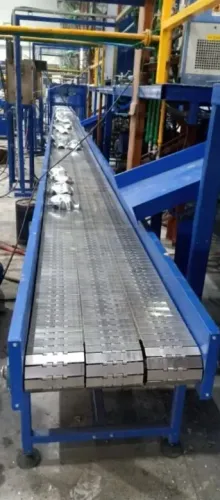
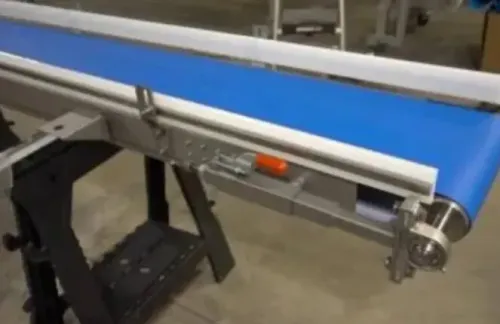
Interlocking plastic modules joined by hinge rods make a modular belt; sprocket teeth engage those modules to pull it. A flat belt is a continuous rubber, PVC or fabric-reinforced strip driven by friction against a pulley.
That distinction affects slip, transfers, repairs and belt tension, but positive drive does not stop products sliding on the belt surface.
| Feature | Modular belt | Flat belt |
|---|---|---|
| Construction | Linked modules with replaceable sections | Continuous strip with a bonded, welded or mechanical splice |
| Drive | Sprocket teeth engage belt cavities | Pulley friction transmits motion |
| Tracking | Aligned sprockets, guides and shafts keep modules engaged | Pulley alignment, crowned pulleys, tracking devices or guided edges control drift |
| Transfer | Some designs use small sprockets or nosebars; the belt’s specified minimum radius still applies | Minimum pulley and transfer diameters depend on belt construction and splice type |
In a modular conveyor comparison, tracking is not maintenance-free: misaligned sprockets or worn teeth cause abnormal movement. Modular belts can drain water through openings, while solid-top modules and flat belts retain small parts and fines on a continuous surface.
Plastic modules also expand more than the conveyor frame during hot washdown or temperature changes, so the design must allow for take-up, catenary and correct sprocket engagement.
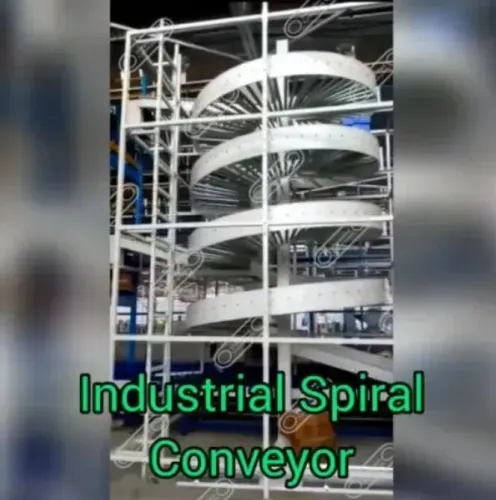
For belt conveyors for production lines, choose by transfer radius and containment as well as traction. Neither belt type automatically wins on inclines: both can use cleats, flights, sidewalls or textured surfaces, with product stability and discharge geometry deciding the result.
Which belt fits your product and operating conditions?
A small product with a rough underside can catch at transfers or drag on a seam; a heavy product can expose belt-tension and support limits. Start with product geometry and load, then test the surface against temperature, moisture, chemicals, speed, incline and accumulation.
| Factor | Flat belt | Modular belt |
|---|---|---|
| Product size and underside | Continuous support suits small items and uneven bottoms; inspect transfer gaps. | Openings and hinge joints can disturb tiny items; choose a fine-pitch surface. |
| Weight | Confirm belt rating, support spacing and splice strength. | Calculate effective tension using belt mass, friction, starts, stops, incline and accumulation. |
| Temperature | Check belt material and splice limits. | Allow for plastic expansion after hot washdown or oven exposure; verify take-up and sprocket engagement. |
| Moisture and chemicals | Select a cover that resists oil, water and cleaning agents. | Check polymer, rods, hinges and drainage; open joints can retain residue and chemicals. |
| Speed | Smooth belts suit high-speed, continuous transport when tracking remains stable. | Confirm the belt-series speed rating, sprocket arrangement and product stability. |
| Incline | Add texture, cleats or sidewalls when products slide or roll back. | The same profiles are available; choose from product grip, cleat pitch and discharge needs. |
| Accumulation | Use a low-friction surface only when pressure and heat are acceptable. | Use a design rated for the accumulated load, not just the belt width. |
For modular belt conveyors in Coimbatore, compare process data rather than location. Ask suppliers to verify compatible modules, rods, sprockets, belt chemistry and local service support against your duty cycle and sanitation method.
How do surfaces and transfers change the production-line result?
Use a smooth surface for stable, dry products that need continuous support and clean release at discharge. Choose a textured belt when moisture, oil or a light incline causes sliding; texture improves grip, but it does not stop a heavy product from moving during acceleration or accumulation.
Flights or cleats provide positive support on steeper inclines and control product spacing. Sidewalls contain loose, small or irregular products, but they increase cleaning effort and can trap residue at the belt edge.
Neither profile makes a flat belt conveyor alternative unsuitable for inclined conveying; check the product’s stability, incline angle, cleat pitch, loading impact and discharge clearance.
Transfer geometry often decides the result. A modular belt can use small sprockets or a nosebar only when its construction permits that minimum radius. A flat belt also has minimum pulley and transfer diameters determined by its carcass and splice. Ignore those limits and the belt can crack, lift at the transfer or lose product.
For belt conveyors for production lines, check these points before choosing the belt:
- Small products need a tight transfer gap, supported edges or a belt opening smaller than the product; open modular belts can let pieces, fragments and liquid fall through.
- Accumulation needs low-friction support and controlled back-pressure; positive sprocket drive prevents drive slip but does not stop products sliding on the belt.
- Choose solid-top modular or flat construction when fines must remain on the belt; choose an open modular surface when drainage matters more than containment.
- Match flights, cleats and sidewalls to the discharge method, not simply to the incline.
What will cleaning, repairs and ownership actually require?
A damaged modular belt section can usually be removed by pulling hinge rods and replacing modules; a flat belt normally needs a complete endless belt, a vulcanised splice or mechanical fasteners.
Modular ownership therefore demands compatible modules, hinge rods and sprockets in stock, while flat-belt ownership demands the correct belt length, splice kit and trained repair support.
| Option | Cleaning and repair reality | Cost consequence |
|---|---|---|
| Modular belt | Openings can improve drainage and access, but hinges, rods and underside spaces can trap residue or chemicals. Replace damaged sections without removing the entire belt. | Higher belt and spare-part complexity; lower downtime when parts are available. |
| Flat belt | Smooth surfaces are quick to wipe, but the frame, return path and belt underside can restrict access. Splice work requires alignment, tension control and curing or fastening time. | Lower initial cost and fewer belt-specific spares; a failed splice can stop the whole conveyor. |
Washdown performance depends on the complete design, not the label “food grade” or “washdown.” Specify open frames, sloped surfaces, drain points, corrosion-resistant components and chemical compatibility; otherwise water, oil or caustic cleaner will collect around bearings and supports.
Compare lifecycle cost using these inputs:
- Belt price, sprockets or pulleys, hinge rods and splice materials
- Cleaning labour, water, detergent and access time
- Expected replacement frequency and downtime cost
- Local availability of compatible parts and service
A modular conveyor comparison favours modular belts when frequent washdown, positive drive, flights or rapid section replacement matter. Choose a flat belt when smooth continuous support, quiet dry conveying, low initial cost and simple splicing matter more. Neither is automatically cheaper over its service life.
How should you specify the conveyor before requesting a quote?
Specify the conveyor line by line, not by plant-wide preference. For each section, choose the belt that meets the process condition at the lowest total cost after cleaning, spares, splice work and downtime.
| Condition | Lean toward modular belt | Lean toward flat belt |
|---|---|---|
| Positive traction or incline | Sprocket drive, flights or cleats | Use only where friction and incline are adequate |
| Washdown and drainage | Open construction, removable sections | Enclosed surface if dry cleaning is sufficient |
| Small transfer | Confirm the belt’s minimum radius | Confirm pulley, nosebar and splice limits |
| Dry, smooth conveying | When frequent belt-section replacement matters | Low profile, quiet running and continuous support |
| Accumulation | Confirm allowable belt pull and product back-pressure | Confirm belt cover and drive capacity |
Put these figures on the quote request:
- Product dimensions, mass per item, underside material, hourly throughput and accumulation length.
- Belt width, line length, incline angle, elevation change, speed range and start-stop frequency.
- Transfer gap, pulley or sprocket diameter, loading method and discharge height.
- Temperature, moisture, oil, detergent, sanitiser and washdown pressure.
- Required belt surface, flights, cleats, sidewalls, guides and product-contact material.
- Motor rating with calculated effective tension, including belt mass, friction, incline and accumulation.
- Spare modules, rods, sprockets or pulleys, replacement method, guarding and service response.
For modular belt conveyors versus flat belt conveyors in Coimbatore, compare these line sheets rather than generic claims. For modular belt conveyors in Coimbatore, ask Integrated Conveyors And Pacline Automation Technologies to identify compatible belt-series parts and local service support against those figures.
Frequently asked questions
What mechanically separates modular belts from flat belts?
A modular belt uses interlocking plastic modules, hinge rods and sprockets for positive drive. A flat belt is a continuous rubber, PVC or fabric-reinforced strip driven by friction against pulleys.
Which belt fits your product and operating conditions?
Choose based on product shape, weight, surface sensitivity, speed, incline, moisture, temperature, washdown chemicals and required belt tracking. Modular belts suit positive drive and demanding cleaning; flat belts suit smooth, simple conveying.
How do surfaces and transfers affect production-line performance?
Belt surface, flight design, nose-bar transfers, dead plates and transfer gaps affect grip, product orientation, jams and damage. Match the belt and transfer arrangement to the product footprint and handling direction.
What do cleaning, repairs and ownership require?
Modular belts allow section replacement and access around sprockets, but hinge rods and belt joints need inspection. Flat belts have fewer interlocking parts, while full-belt replacement and tracking work can take longer.
What information should you provide before requesting a conveyor quote?
Provide product dimensions and weight, required throughput, belt speed, conveyor length and width, elevation, transfer details, operating temperature, washdown method, belt material and available floor space.
Keywords