A suspended conveyor can clear space below a bottling line, but its value depends on bottle stability, building structure, washdown conditions and the interfaces between machines. By the end, you will be able to match the conveyor arrangement to your bottles, compare alternatives and write a specification that avoids tipping, collisions, sanitation problems and costly line stoppages.
Key takeaways
- Keep belt height, speed and centreline aligned at every bottle transfer.
- Choose belt width and guides for each bottle diameter, height and material.
- Use suspended conveyors when open floors and clear machine access matter.
- Include supports, transfers, controls and installation in the project cost.
Where the conveyor fits from bottle infeed to case packing
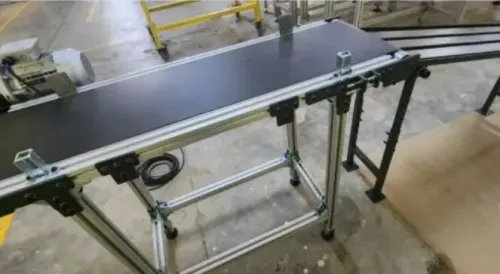
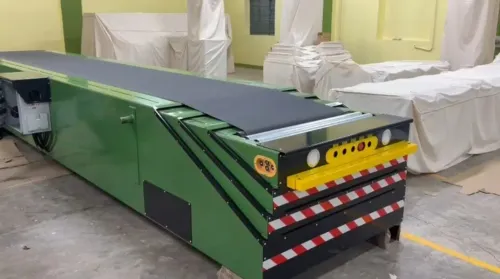
A hanging flat belt conveyor carries bottles on their bases while its suspended frame keeps the floor open beneath the route. At every handoff, the belt must meet the next machine at the same height, speed and centreline; otherwise bottles lean, collide or enter the machine out of sequence.
- At bottle infeed, a floor conveyor or depalletiser places bottles onto the moving belt through a short, level transfer plate. Side guides close the gap without gripping the container.
- Before filling, the belt presents a single, stable lane to the filler infeed. A controlled gap prevents bottles from pushing into the starwheel or indexing mechanism.
- After filling, the conveyor receives bottles from the filler discharge and carries them to the capper without allowing liquid-weighted bottles to sway.
- After capping, guide rails keep the taller load upright as it passes toward labelling. Leave clearance for the label head, coding printhead and inspection camera.
- At inspection and rejection, the belt maintains a fixed bottle position while sensors check cap presence, label placement or fill level. A reject device removes failed bottles without stopping accepted flow.
- At packing, the conveyor meters bottles into groups, shrink-wrap equipment or cartons, then transfers those groups to the case packer through a dead plate, belt-to-belt transfer or machine infeed.
A flat belt conveyor for bottling works best when transfers are independently levelled and the suspended frame is rigidly braced. That is the practical test for a bottling conveyor in Coimbatore: inspect every interface, not just whether the belt runs smoothly on its own.
Match the belt to bottle format and Coimbatore plant conditions
Filled PET, rigid glass bottles and cans suit a suspended flat belt when their bases are stable and the belt supports the load continuously. Diameter, height, weight and centre of gravity decide whether a bottle tracks upright; tall, narrow bottles need closer side guides and lower acceleration.
Empty, lightweight PET may suit neck handling or air conveying better than base support.
A practical selection check for Coimbatore conditions includes:
- Specify a belt, bearings and seals for the line’s ambient and product temperature; heat can soften plastics, distort bottles and shorten belt life.
- Use corrosion-resistant frames, sealed components and openable guards where humidity, syrup or frequent washdown is present. Avoid horizontal ledges, exposed threaded rod and open tube ends that trap water and dust.
- Confirm drainage before installation. A suspended frame clears the floor for cleaning, drains, pipework or pallet movement, but inaccessible undersides can erase that benefit.
- Have the structure checked for conveyor dead load, bottles, dynamic loads and maintenance access load. Roof height must allow the conveyor, guides, guards and a safe service route without obstructing lighting or sprinklers.
| Container or condition | Fit for a suspended flat belt | Main check |
|---|---|---|
| PET, glass and cans | Good for base-supported, stable formats | Guide spacing, scuffing and centre of gravity |
| Shrink-wrapped packs and cartons | Good if the underside is flat | Pack stability and transfer height |
| Empty lightweight PET | Not automatically the best choice | Compare neck-ring air conveying, noise and available air |
| Dusty or wet areas | Suitable with hygienic detailing | Washdown access, drainage and component sealing |
These hanging flat belt benefits matter only when rigid hangers, lateral bracing and independent levelling prevent sway and belt misalignment. That is the real basis for hanging flat belt conveyor benefits for bottling in coimbatore.
Compare the suspended layout with other bottle conveyors
Choose a hanging flat belt when clear floor space, drainage access or pallet movement matters more than maximum speed. Its advantage disappears if the roof needs expensive reinforcement or the suspended frame sways beside a filler, capper or labeller.
| Option | Strength compared with a hanging flat belt | Choose it when |
|---|---|---|
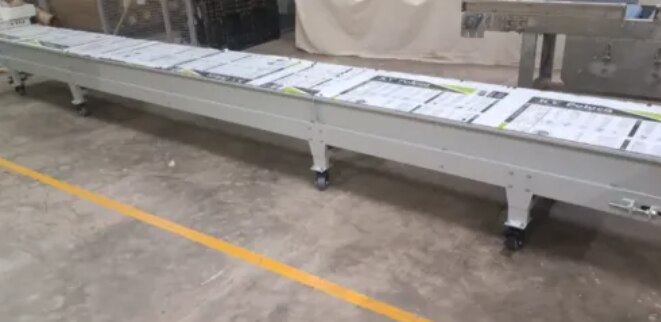
| Floor-mounted flat belt | Simpler support structure and easier belt access, but it occupies floor space and can block cleaning routes or drains. | The layout has spare floor area and the roof cannot carry added load. |
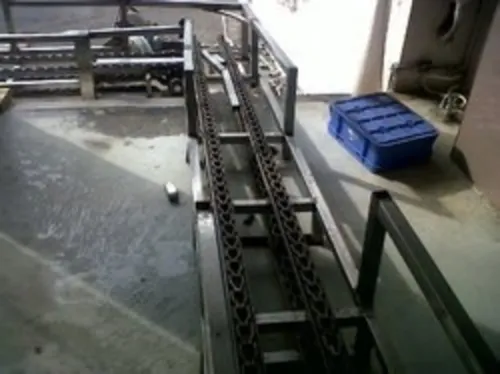
| Slat-chain conveyor | Better for wet handling, accumulation and repeated format changes; chain joints can scuff labels and create more cleaning points. | Bottles need controlled accumulation or the line runs through frequent washdown. |
| Roller conveyor | Efficient for cartons, cases and rigid packs, but individual bottles can rotate, stall or fall between rollers. | You are moving secondary packaging rather than unsupported bottles. |
| Overhead chain conveyor | Leaves the floor clear and can grip empty PET by its neck ring; it needs compatible neck finishes and does not support the bottle base. | Lightweight empty bottles have a strong neck ring and the route suits neck handling. |
| Table-top chain conveyor | Handles single-file bottles, curves and accumulation with established bottle guides; it needs careful lubrication, alignment and changeover adjustment. | You need a conventional high-throughput bottle line with multiple lanes or tight transfers. |
The main hanging flat belt benefits are underneath the line: access for operators, pipework, drains and cleaning equipment. A flat belt conveyor for bottling is the weaker choice for soft, unstable empty PET unless side guides, belt friction and transfers are tightly controlled.
Compare total installed cost, including bracing, washdown access, belt replacement, format-change time, controls and locally available spares—not just the conveyor frame. A suspended layout is worthwhile only after checking dead load, bottles, dynamic forces and maintenance access load.
Design transfers, guides and controls to keep bottles upright
Keep the bottle base fully supported through every handoff. A short gap can let a narrow bottle bridge, rotate or fall, so use a nose-bar transfer, dead plate, transfer roller or controlled belt overlap matched to bottle diameter, base shape and line speed.
Specify the flat belt conveyor system for packaging around these controls:
- Set adjustable, low-friction side guides close enough to prevent yaw and tipping, but never clamp the bottle. Too little clearance causes collisions; too much permits scuffing and instability.
- Use rigid hangers, lateral bracing and an independently levelled frame. Sway or belt misalignment at a filler, capper, labeller or vision station creates tracking faults.
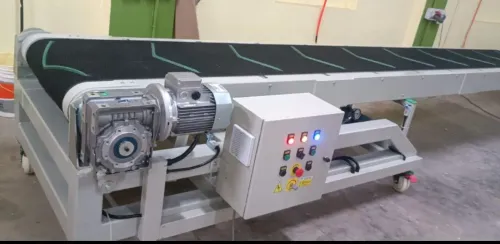
- Add photoelectric sensors before transfers, reject stations and accumulation zones. Interlock the upstream drive when the downstream machine is blocked instead of pushing bottles into a jam.
- Use variable-speed drives and zero-pressure accumulation where space permits. A continuous push builds back-pressure, raises motor load and rubs labels or bottle walls.
- Provide guide adjustment scales, belt-tracking adjustment, guarding, emergency stops and access for belt removal.
| Risk | Mechanical detail | Control detail |
|---|---|---|
| Tipping or sliding | Supported base, short transfer gap, correct belt friction | Match speed at the handoff |
| Scuffing or back-pressure | Low-friction guides without clamping | Stop or slow upstream accumulation |
| Collisions | Separate lanes and controlled guide entry | Sensor-based spacing and reject logic |
For empty, lightweight PET, compare this arrangement with neck-handling or air conveying: those methods use the neck ring and keep the flexible body off the belt, while a flat belt depends on base stability.
Calculate the installed decision, not just the conveyor price
A lower conveyor price does not make a lower-cost line. Include supports, drainage alterations, washdown labour, belt-removal access, format-change time, controls integration and local spare-part availability when comparing a bottling conveyor in Coimbatore. These items often determine the installed and maintained cost.
1. Specify the operating result: bottles per minute, container pitch, bottle diameter and height, product weight, belt speed, accumulation length, incline, reject station, coder or labeller clearance, infeed and discharge transfers, side guides, guarding, emergency stops and belt-removal method.
A flat belt conveyor system for packaging must connect to the machines around it, not only run correctly by itself.
2. Obtain a structural review covering dead load, bottle load, dynamic load and maintenance access load. Require hanger locations, lateral bracing, allowable deflection, sway control, drainage routes and an independently levelled frame; an existing roof is not automatically a suitable support.
3. Make commissioning prove each interface. Test empty and full bottles through start-stop cycles, accumulation, transfers, rejects, coding clearance and emergency stops, then record speed, pitch, motor current, tracking and restart behaviour after washdown.
4. Compare suppliers using the same drawing and duty cycle. Ask for guarding details at pulleys, take-ups, return rollers and belt-to-frame nips, plus belt replacement time, spare-part lead times, service coverage and changeover labour. Integrated Conveyors And Pacline Automation Technologies should be asked for these measurable deliverables when its proposal is compared with alternatives.
The useful hanging flat belt benefits for bottling in Coimbatore are floor clearance and maintainability only when the structure, interfaces and lifecycle costs are documented.
Related products
 | BELT CONVEYOR A Hanging Flat Belt Conveyor with Rough Top Belt Conveyor is an overhead material handling system designed to provide smooth horizontal... View product → |
 | CONVEYOR HANGING FLAT BELT WITH ROLLER CONVEYOR A Hanging Flat Belt with Roller Conveyor is an overhead material handling system that combines the smooth transportation of a flat belt conveyor with... View product → |
Frequently asked questions
Where does a hanging flat belt conveyor fit on a bottling line?
It can carry bottles from infeed through filling, capping, labelling and inspection to case packing, provided each transfer matches the next machine’s height, speed and centreline.
How do you match a flat belt conveyor to Coimbatore plant conditions?
Specify the bottle diameter, height, weight, material, required speed and cleaning method, then account for heat, dust, humidity, washdown exposure and available ceiling structure.
When is a suspended bottle conveyor better than a floor-mounted conveyor?
Choose the suspended layout when you need open floor space, clear access below the route or separation from forklifts and operators. A floor-mounted conveyor can be simpler where ceiling supports are unavailable.
What should you include when calculating the installed conveyor cost?
Include the belt, frame, motor, supports, transfers, side guides, sensors, controls, guarding, installation, electrical work, commissioning and any building or ceiling reinforcement.
Related product
 | BELT CONVEYOR A Flat Belt Conveyor is the backbone of any production line. If this fails, everything after it fails. Simple machine, serious job. View product → |
Keywords