Pharmaceutical cartons need more than a moving belt: the loading sequence must protect seals, labels, batch identity, and carton structure while the truck remains secure. By the end, you can map the operating steps, specify the equipment against your carton and bay conditions, and question a Coimbatore supplier with enough detail to avoid an unsuitable installation.
Key takeaways
- Inspect the trailer and secure it before extending the conveyor.
- Use barcode scans, batch checks and lane segregation to protect traceability.
- Match belt width, boom reach and speed to carton dimensions and dispatch rate.
- Confirm dock dimensions, electrical supply and emergency stops before ordering.
What happens from dispatch conveyor to the truck interior?
Vehicle arrival starts with inspection, not belt movement. Check the trailer floor, internal height, sidewalls, restraints, obstructions and boom-nose clearance, then apply wheel chocks or the site’s vehicle restraint. A telescopic conveyor cannot compensate for a trailer that moves away from the dock.
1. Confirm alignment. At a level dock, match the conveyor and trailer-floor height. At a floor-level bay, use height adjustment, articulation or a dock leveller; extension changes reach, not floor height.
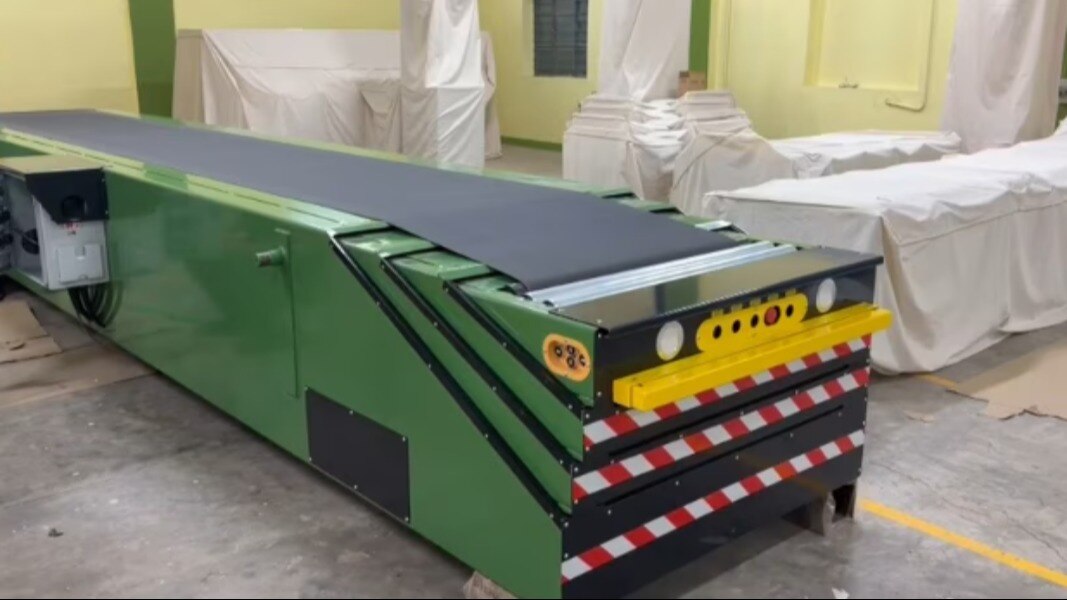
2. Set boom height and extension so the nose reaches the working area without touching the roof, floor or walls. Start the belt only after guards, emergency stops and the transfer from the dispatch conveyor are clear.
3. Feed cartons at a controlled speed and pitch. The operator at the nose builds a straight, stable row with small, consistent gaps, keeping labels visible and preventing uncontrolled back-pressure.
4. Never drive the boom into cartons or use it to push them against the front wall or sidewalls. Extend as the load advances; stop the belt before changing boom position. Retract when the remaining space no longer requires the extension.
5. For shutdown, stop carton feed, let the belt clear, then stop the conveyor. Confirm nobody remains inside the vehicle before retracting the boom.
6. Clean the dispatch transfer, belt edges, nose and surrounding floor, removing dust or carton fragments before the next pharmaceutical load. This sequence defines safe telescopic conveyor system operation for a telescopic truck loading conveyor.
How do you prevent carton damage, mix-ups, and loss of traceability?
A pharmaceutical carton loading conveyor handles finished shipping cartons, not loose blister strips, bottles, or vials. Keep each carton upright in its validated orientation, with product name, strength, batch number, expiry date, and tamper-evident seal visible and readable; reject crushed cartons or illegible labels.
Use separate pallets, trailer zones, or route lanes for each batch, customer shipment, and SKU. Load mixed SKUs only when the batch record and dispatch plan permit it: scan each carton, preserve physical separation, and reconcile quantities before closing the vehicle.
- Set adjustable speed, controlled acceleration and deceleration, a level nose transition, and enough side clearance at the boom end. Uncontrolled back-pressure can scuff, crush, or trap cartons; a telescopic conveyor is not automatically a zero-pressure accumulation conveyor.
- During telescopic conveyor system operation, stop and isolate the conveyor for every product, batch, or shipment changeover. Remove every carton, then inspect belt edges, rollers, guides, transfer gaps, and the trailer floor for dust or debris.
- Reconcile carton counts with scan records and document the line clearance, including the operator, time, trailer, and result.
- Do not leave temperature-sensitive cartons on an exposed dock or in a hot trailer while positioning the boom. Follow the site GDP procedure for vehicle preconditioning, door-open time, temperature mapping, and monitoring.
Which conveyor specifications match your cartons and dispatch rate?
A 0.30 m carton on a 0.50 m pitch, travelling at 30 m/min, gives about 60 cartons per minute before gaps, stops, misfeeds, and handling losses. Use cartons per minute, not tonnes per hour, to size a pharmaceutical carton loading conveyor.
The formula is belt speed in metres per minute divided by carton pitch in metres.
Provide these inputs before comparing a telescopic truck loading conveyor:
- Minimum and maximum carton length, width, height, mass, case format, orientation, cartons per minute, daily duty cycle, and truck type.
- Belt width, adjustable belt speed, rated load per metre, usable boom reach, telescopic-stage count, nose loading-height range, incline limit, turning clearance, noise, electrical supply, earthing, enclosure protection, and cleaning limitations.
| Requirement | Add-on or control | When it applies |
|---|---|---|
| Powered infeed | Feeds cartons at a controlled rate | Dispatch conveyor cannot match the loading speed |
| Accumulation conveyor | Separately designed queueing section | Cartons must wait without contact pressure |
| Roller conveyor | Handles rigid, stable case bottoms | Cartons need transfer or staging |
| Barcode scanner, weighing station, reject lane | Verifies identity, mass, and diversion | Traceability or weight checks occur before loading |
| Operator pendant | Puts start, stop, speed, and extension controls at the boom | The operator works inside or beside the truck |
A standard belt conveyor is not automatically zero-pressure accumulation equipment. Add barcode, weighing, or rejection controls only after defining the inspection point and response to a failed carton.
Will the conveyor fit your Coimbatore loading bay safely?
A safe quotation starts with a measured bay, not a nominal boom length. For a telescopic conveyor in coimbatore, survey the installation and fleet together: extension cannot correct a height mismatch or an unstable vehicle.
1. Record dock height; vehicle-floor height across the fleet; trailer and container dimensions; bay depth; ceiling clearance; column locations; door width; approach space; turning path; floor flatness; drainage; and floor load capacity.
2. Mark the reach envelope. Confirm the boom reaches the far end without blocking the door, emergency route, or adjacent bay. Before extension, inspect each incoming vehicle for floor damage, internal-height restrictions, loose restraints or obstructions, damaged sidewalls, and clearance around the nose.
3. Confirm wheel chocks or a vehicle restraint, emergency-stop locations, guards at pulleys, rollers, telescoping sections, and boom-to-frame interfaces, plus belt-start warnings. Check access beneath the boom, operator position, extension limits, and isolation points for electrical, drive, height, and dock mechanisms.
4. Define the telescopic conveyor system operation: secure the vehicle before extending, feed only at a stackable rate, and stop before repositioning. Never overload the belt, use the boom as a support, or enter the trailer during retraction; isolate stored energy before clearing a jam.
When is telescopic loading better than the alternatives?
Choose a telescopic truck loading conveyor when loose cartons must reach deep into trailers at a repeatable dispatch rate, but palletised loads or highly variable bays may favour another method. The decision depends on cartons per minute, trailer mix, route segregation, loading frequency, staffing and changeover time.
| Option | Best fit | Main limitation |
|---|---|---|
| Manual loading | Low volume, irregular cartons, or bays without equipment | Longest carrying distance and greatest manual effort |
| Fixed dock conveyor | Stable bay layout and repeatable vehicle position | Poor fit for changing bays or vehicle positions |
| Flexible conveyor | Short runs and frequent layout changes | Limited reach into deep trailers |
| Mobile conveyor | Multiple bays | Positioning and storage consume time |
| Forklift pallet loading | Uniform, palletised shipments | Not suited to loose cases requiring deep placement |
| Telescopic conveyor | Loose-case loading deep inside trailers | Needs space, maintenance and trained operators |
A pharmaceutical carton loading conveyor does not remove staffing needs. Operators still inspect labels, control carton pitch, stack safely, and reconcile quantities; pallet loading is faster only when cartons arrive in consistent pallet patterns.
Before choosing, price the operating burden:
- Operator training and pre-use inspection
- Belt replacement, motor and gearbox servicing
- Bay-change downtime and cleaning time
- Spare-parts availability and service response
- Changeover effort for different carton dimensions
Choose the telescopic option when reduced carrying distance outweighs its positioning, cleaning and maintenance demands.
What should you ask a Coimbatore supplier before placing the order?
Turn the survey into contract evidence, not a brochure comparison. For anyone searching how telescopic conveyor for loads pharmaceutical cartons in coimbatore, the quotation must describe your bay, carton range, vehicle fleet and dispatch controls. Ask Integrated Conveyors And Pacline Automation Technologies to price the measured installation, not a nominal boom length.
1. Require a performance schedule stating usable extension and retraction range, minimum and maximum nose height, belt speed, belt width, carton length, width, height and mass limits, rated load per metre, duty cycle, positioning time, electrical supply, full-load current, earthing, IP rating, noise, contact materials, surface finish and cleaning method.
Specify guarding, emergency-stop response, isolation points and safe extension limits.
2. Request general-arrangement drawings showing columns, doors, vehicle envelopes, turning clearance, operator access and adjacent emergency routes. Require a user requirement specification, risk assessment, operating and cleaning procedures, preventive-maintenance schedule, inspection records, spare-parts list, warranty exclusions, service-response terms and operator-training scope.
3. Put acceptance tests in the purchase order: use minimum and maximum cartons, speed settings, jam recovery, emergency stops, extension limits and representative trailers. Include weighing-station calibration records, barcode verification, line-clearance evidence and change-control rules.
Confirm customisation of the infeed, scanner, reject lane, controls, height adjustment and dock interface; a standard machine may not suit every telescopic conveyor in coimbatore.
Frequently asked questions
What happens from the dispatch conveyor to the truck interior?
Cartons transfer from the dispatch conveyor onto the telescopic conveyor, which extends through the dock opening into the secured trailer. Operators control extension, belt movement and loading position while keeping the carton flow within sight.
How do you prevent pharmaceutical carton damage and mix-ups?
Set belt speed and transfer heights to avoid drops, keep cartons upright when required, separate products by shipment or batch, and scan carton and pallet identifiers at dispatch. Record rejected, damaged and manually diverted cartons.
Which specifications match pharmaceutical cartons and dispatch rate?
Compare carton length, width, height, weight, base condition and required throughput with the belt width, load rating, conveyor speed, transfer height and telescopic reach. Include the largest carton and the highest cartons-per-minute rate in the design check.
Will a telescopic conveyor fit a Coimbatore loading bay safely?
Measure dock height, door width and height, pit or floor space, trailer position, boom clearance and available turning space. Confirm the electrical supply, guarding, emergency stops, operator access and wheel-chock or vehicle-restraint procedure before installation.
When is telescopic loading better than the alternatives?
It suits dispatch bays that load frequent trailers and need reduced walking or manual carrying inside the vehicle. Fixed conveyors suit stable, dedicated routes; pallet trucks suit low volumes or mixed loading patterns; gravity rollers suit cartons that tolerate manual positioning.
Keywords