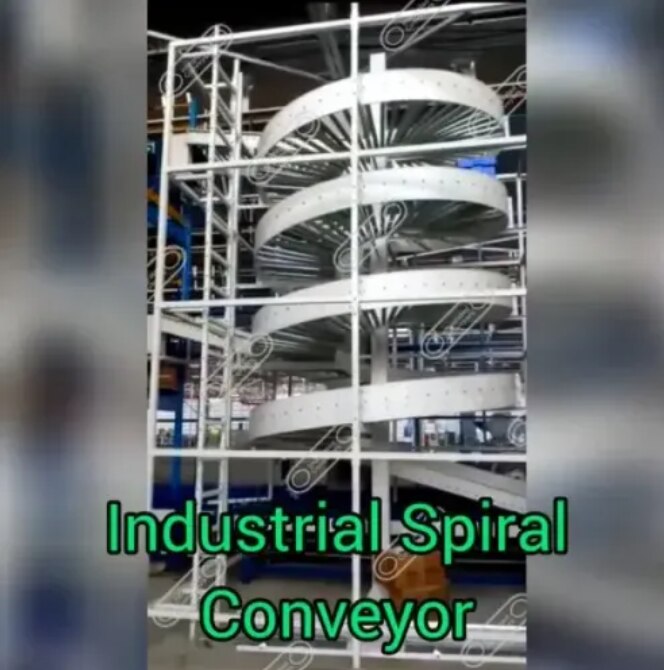
A gravity spiral prevents jams only when the package, roller arrangement, slope and accumulation behaviour are matched; gravity alone does not guarantee smooth flow. By the end, you will be able to screen products, identify likely jam points, compare alternative conveyor types and specify a test that exposes failures before installation.
Key takeaways
- Test carton base rigidity, centre of gravity and dimensions before choosing the spiral.
- Set roller spacing, side guides and transitions so cartons cannot stop one another.
- Treat free-flow accumulation as controlled contact, not pressure-free storage.
- Run a measured jam test at operating rate before continuous production.
The package and roller geometry decide whether gravity flow starts
Gravity flow starts only when the carton’s weight, base and dimensions suit the roller path. The bottom must be flat and rigid enough to bridge roller gaps without sagging, while its centre of gravity stays low enough to resist tipping on the spiral incline.
Keep at least three rollers beneath the smallest carton at every point; long, flexible cartons, bags and irregular totes need closer pitch or another conveying surface.
Before specifying a gravity conveyor system in Tamil Nadu, record:
- Carton length, width, height and mass range, including the smallest and heaviest loads
- Base material, flatness and stiffness; flag shrink-wrapped, bagged, open-bottomed or unstable packages
- Roller diameter and pitch, checked against the shortest package base dimension
- Usable conveyor width, leaving enough clearance for rolling without allowing a carton to rotate into a side guide
- Centre of gravity and the planned spiral incline; more slope can increase speed and impact rather than cure a jam
- Product contact points, including protruding straps, flaps and uneven bottoms
Set usable width slightly wider than the package, not several times wider. Excess width lets cartons yaw, so a corner catches the guide or a carton bridges across adjacent rollers. Side guides must contain the load without rubbing continuously; friction on one edge can stop a light carton while heavier cartons continue behind it.
Test the smallest, softest and lowest-friction package on the actual spiral, because an empty run will not reveal tipping, sagging or bridging.
Spacing, guides and transitions prevent one carton from stopping the next
A carton jams when its leading corner reaches a gap it cannot bridge. Roller pitch must keep the rigid base supported by several rollers; excessive spacing lets soft cartons sag, tip or skew. A larger roller diameter increases contact and reduces corner catches, while an excessive spiral incline can accelerate cartons into collisions.
Usable width means the clear space between guides, not the frame width. Set it for the largest carton plus tolerance for dimensional variation and skew. Guides must stop a load falling without pinching it: a guide that narrows, leans inward or ends abruptly can wedge a carton and stop everything behind it.
Inspect these transfer points closely:
- At the spiral entry, match the incoming roller height and direction so the first carton does not strike a frame edge.
- At changes in roller pitch, avoid a support gap that lets a carton nose drop or bridge.
- At the spiral-to-horizontal discharge, align heights and provide continuous support through the corner.
Any request for a spiral gravity free flow conveyor for system in Coimbatore should include a product trial, not an empty-run demonstration. Test skewed cartons, the smallest and largest loads, soft bases and different friction levels; watch guide clearance, collisions, corner catches and restart after the discharge stops.
A carton reaching the bottom once proves very little.
Free flow is not pressure-free accumulation
Free flow does not mean pressure-free accumulation. If the discharge stops, the leading carton stops while cartons behind it continue rolling down the incline. Without braking, controlled accumulation zones or positive gap control, compression builds until cartons crush, skew, wedge against guides or block the spiral.
Control the build-up in this order:
1. Stop upstream inflow with a full-zone sensor or operator interlock when the discharge is blocked. Do not use the spiral’s usable length as unlimited storage; capacity falls as product spacing increases.
2. Run a loaded trial with the smallest, largest, lightest, heaviest, highest-friction and lowest-friction cartons. Include soft or sagging bases, skewed loads, loose shrink-wrap and unstable centres of gravity.
3. Set spiral incline, roller resistance, braking and spacing so cartons arrive at a controlled speed and retain a visible gap. A low-friction carton that catches the next load creates impact; excessive braking leaves cartons stopped across roller gaps.
4. Test a blocked discharge and restart. Check back pressure, side-guide contact, corner catches, crushed packaging and whether the first carton releases without launching into the next one.
If you are investigating free flow conveyor jams in coimbatore, specify the maximum accumulation length, package spacing and allowable back pressure before requesting a design. Approve the conveyor only after repeated loaded cycles show consistent flow, safe stopping and undamaged cartons.
Choose the conveyor type that matches the product and rate
A gravity spiral is the wrong choice when the load needs positive orientation, controlled spacing, or reliable movement at a high rate. Uneven bases, high centres of gravity, loose shrink-wrap and soft cartons can rotate, tip or catch guides instead of travelling consistently.
| Option | Choose it when | Gravity spiral is wrong when |
|---|---|---|
| Powered spiral | You need a controlled rate, positive movement, or consistent gaps between levels | The product must be driven through variable friction, inclines or frequent starts and stops |
| Straight gravity roller conveyor | The elevation change is small and you have a long, direct path | A compact vertical route is essential, or the required slope would make cartons run too fast |
| Skate-wheel conveyor | Loads have rigid, flat bases and need flexible, low-load conveying | Bags, open-bottomed packs, narrow cartons or unstable loads can bridge between wheels |
| Vertical reciprocating conveyor | You need a defined lift between floors and can move batches or single loads | Continuous flow is required, or stopping for each lift would restrict hourly throughput |
| Lift | Vertical transfer is occasional and space or rate does not justify conveyor length | You need continuous accumulation and discharge without lift-cycle delays |
Gravity capacity is also limited by usable spiral length and product spacing. If the discharge stops, following cartons keep rolling into the first carton unless braking, controlled zones or an upstream full-zone stop limits pressure; crushed corners and jams follow.
Treat spiral gravity roller conveyor problems as a reason to retest the actual product and rate, not an empty conveyor. Integrated Conveyors And Pacline Automation Technologies should receive the mass range, base condition, hourly rate, accumulation length and elevation difference so a representative trial tests mixed sizes and restart behaviour.
Related products
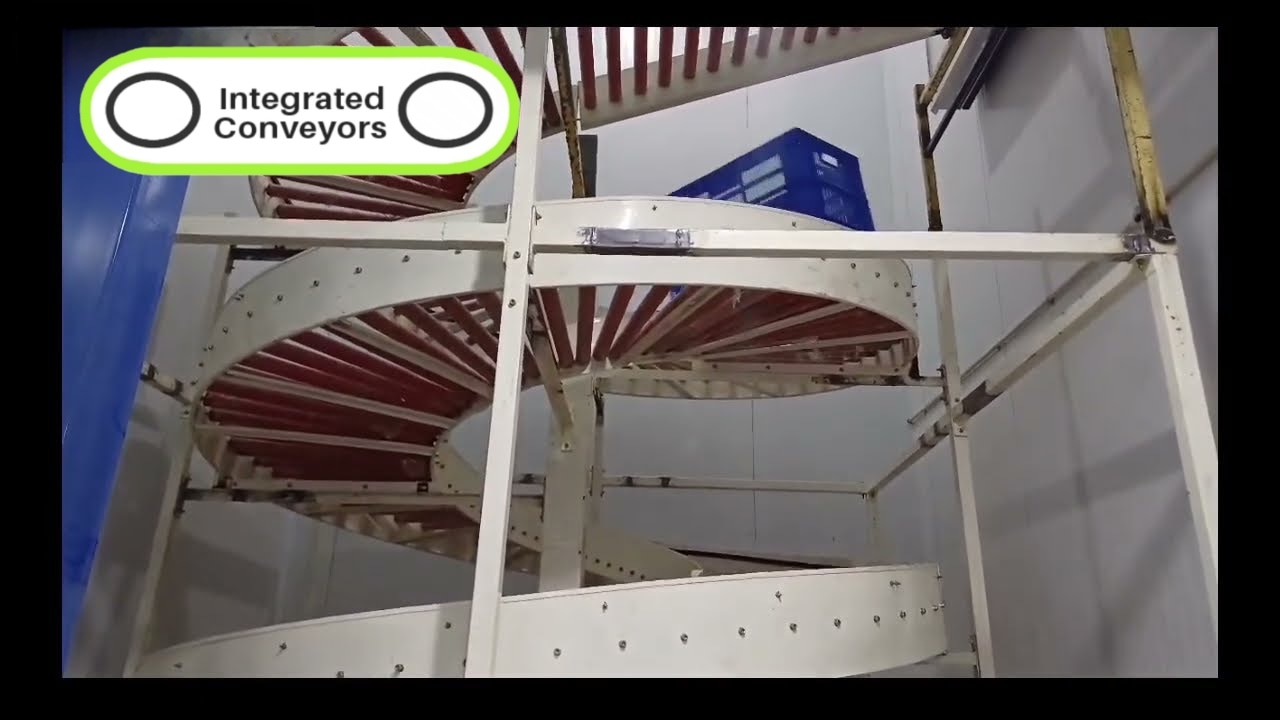 | Conveyor SPIRAL GRAVITY FREE FLOW ROLLER CONVEYOR 🔷 SPIRAL GRAVITY FREE FLOW ROLLER CONVEYOR Description: The Spiral Gravity Free Flow Roller Conveyor is a space-saving and cost-effective solution... View product → |
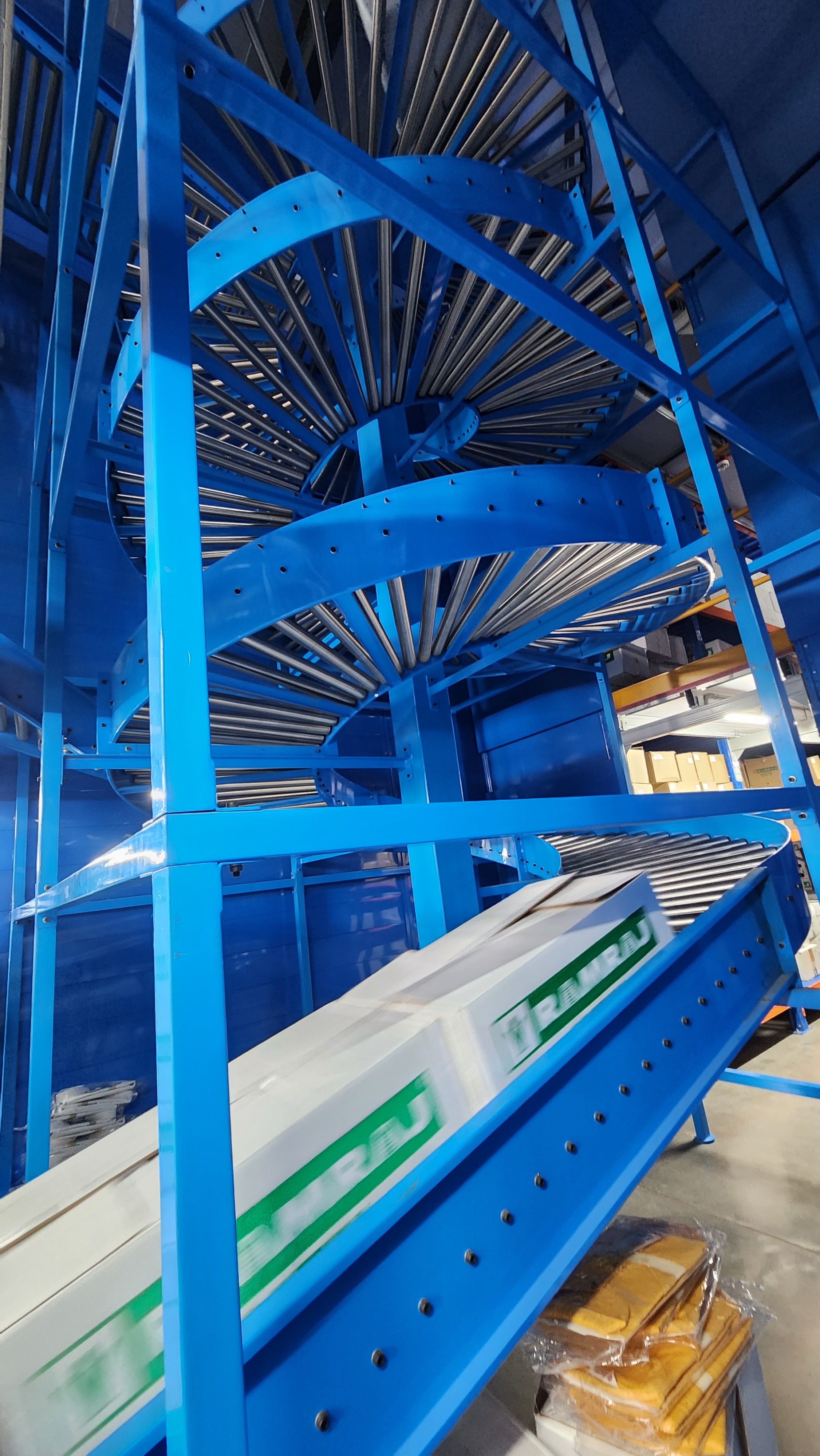 | SPIRAL MS SPIRAL FREE ROLLER CONVRYOR The Spiral Conveyor is a compact, high-efficiency vertical transport system designed to move products between different elevations while occupying... View product → |
Use a measured troubleshooting and acceptance test before continuous operation
A sound spiral roller conveyor troubleshooting sequence starts at the first stopped carton, not at the visible pile-up. Do not reach into the spiral: stop the conveyor, isolate its energy, and confirm that rollers, shafts, transfer gaps and nip points cannot move before clearing product.
1. Mark the first stoppage, remove every carton from the affected section, and record whether the load is skewed, damaged, tipped or rotating.
2. Rotate each roller by hand. Replace or repair seized bearings, bent shafts and damaged rollers before testing again.
3. Check that the conveyor is level across its width. Measure roller pitch, usable width and side-guide clearance against the package dimensions; a tight guide or excessive gap can recreate the jam.
4. Run one package at a time. Confirm steady movement, controlled speed and a repeatable transfer at every entry, exit and change in elevation.
5. Test the smallest, largest, lightest, heaviest, highest-friction and lowest-friction packages, including soft cartons, uneven bases, shrink-wrapped loads and products with high centres of gravity.
6. Introduce mixed packages at the intended rate and accumulation condition. Watch for collision, skew, corner catches, crushed packaging and rising back pressure; free flow is not pressure-free accumulation.
7. Stop the discharge, allow the spiral to load, then restart it. Approve continuous operation only when packages separate, move without impact and recover safely through repeated stop-start cycles. A failed variant needs containment, braking, powered control or a different conveyor—not a removed guard.
Frequently asked questions
What determines whether a carton will move on a spiral gravity conveyor?
The carton needs a flat, rigid base that bridges the roller gaps, plus dimensions and a low centre of gravity suited to the spiral incline.
How do roller spacing, guides and transitions prevent carton jams?
Correct roller spacing supports the carton base, while aligned side guides and smooth transitions prevent skewing, tipping and one carton blocking the next.
Is free-flow accumulation pressure-free?
No. Cartons still contact one another and create back pressure, so the conveyor must control accumulation rather than assume pressure is absent.
How should you troubleshoot and accept a spiral gravity conveyor?
Check carton geometry, roller condition, guide alignment, transitions and operating rate, then run a measured test before approving continuous operation.
Keywords